Sunday, August 21, 2011

Beware the Moon and Stick To the Road


The following is an article I wrote for the blog Edward Copeland on Film (for which I am a regular contributor) commemorating the 30th anniversary of the release of An American Werewolf in London.


1981 was a seminal year for werewolf movies. First, Joe Dante's The Howling hit theaters in April followed by Michael Wadleigh's Wolfen in July and, finally, John Landis' An American Werewolf in London in August. It is the latter title with which this article will be concerned, primarily because today marks the 30th anniversary of its release but also because, in the opinion of this critic, Landis' picture not only is the best of the three werewolf films released that year but, arguably, the best werewolf film ever made. I still remember the first time I was exposed to it. I was no older than 10 and for some strange reason my parents thought it would be appropriate for me to watch. They changed their minds shortly into the film and promptly sent me to bed, but by then it was too late: the damage had been done. Though I wouldn't see the film in its entirety until years later, that opening sequence where two young Americans hikers get attacked by a vicious beast while walking through the English countryside at night had been permanently etched in my memory. To this day, it is one of the most terrifying sequences I've seen on screen and I've had many a nightmare because of it.

What makes An American Werewolf in London work so beautifully (besides how effectively scary it can be), is its tongue-in-cheek sensibility. It is commonplace to see humor blended with horror in movies nowadays but back in '81 it was far more outrĂ©. The comedy manifests itself in many different forms…such as in Landis' choice of music. He brilliantly peppers the soundtrack with classic songs that feature the word "moon" in the title ("Bad Moon Rising," "Moondance" and "Blue Moon"), thus underscoring the absurdity of many of the things being depicted onscreen. For example, during the now iconic transformation scene while the character David (David Naughton) thrashes about on the floor as his body slowly and painfully changes into a werewolf, we hear one of the three versions of "Blue Moon" used in the film playing in the background. The juxtaposition of the sweet and the sickening makes for a simultaneously scary and funny (not to mention incredibly memorable) sequence. Even the characters themselves comment on how ridiculous many of the things they're experiencing are. When David's friend Jack (Griffin Dunne) returns from the dead to inform David that since he will soon become a werewolf he must commit suicide, David says he will not be threatened by a "walking meatloaf"…an epithet which he later apologizes for during his metamorphosis (incidentally, throughout the course of the film every time Jack appears to David he does so in increasingly decaying forms; it is both gruesome and hysterical).

In fact, many of the lines in the film clearly are designed to poke fun at the bizarre goings-on in the story. "A naked man stole my balloons"; "Have you ever tried talking to a corpse? It's boring."; and "Sean, I think there are some hooligans in the park again" are just some of the many gems to be found in the film's dialogue. My personal favorite comes when David realizes he truly is a werewolf and thus attempts to get himself arrested, spouting off the kind of horribly irreverent nonsense that every typical American thinks would offend his uptight British neighbors ("Queen Elizabeth is a man! Prince Charles is a faggot! Winston Churchill was full of shit! Shakespeare's French!"). It is impossible for me to watch the film and hear David's anti-English rant without laughing out loud. Landis also does something that was relatively new for its time. Much as Wes Craven did years later in the first Scream, Landis populates his horror film with characters who have actually seen other horror films. When David talks to his girlfriend (Jenny Agutter) about Claude Rains and Lon Chaney Jr. in 1941's The Wolf Man, it may not be the first example of meta-cinema in a scary movie, but is a rare (for its time) case of movie characters acknowledging that their lives seem to resemble the trappings of a horror movie.

However, the laughs (of which there are plenty) that the film provokes do not in any way lessen the impact of the horror scenes. If anything, they just throw them into sharper contrast. The atmospheric opening section of the film, a suspenseful foot chase through the underground tunnels of Tottenham Court Road tube station (where the camera adopts the POV of the wolf, though it is never actually seen except briefly from a distance in the scene's penultimate shot) and especially some horrific nightmares experienced by David after he is bitten are all frighteningly visceral sequences. And, of course, there is the aforementioned extended transformation scene where another stellar element of the film is highlighted: namely, the superb special effects. Landis' idea was that David's change into the werewolf would be more traumatic than simply growing hair (through a cheesy optical dissolve) and then howling at the moon. It would be a more "realistic" transmogrification involving skin stretching, bones popping and cracking, cries of sheer agony and it goes on for quite a while. Landis does not let his character off the hook with a quick conversion. He also does not conceal his effects in shadows. He has it take place right out there in the open, harsh light. Nowadays the scene would be done with CGI. In the '80s, they had to use physical effects that took a great deal of time and labor to produce (often for only a second of a half of screen time). Still, the scene and the movie is the better for it. Naturally Landis owes a lot to the genius of the great Rick Baker (who also consulted on the makeup effects for The Howling). Baker's work for the film was so magnificent that it inspired the Academy of Motion Picture Arts and Sciences to create a new category for makeup (for which Baker received the first Oscar for this movie).

An American Werewolf in London opened to big box office success and generally positive reviews. It became known as a "game-changer" in the genre of horror and in particular in the makeup/special effects arena of said genre. It spawned a successful radio adaptation, a highly inferior 1997 sequel and is apparently set to be remade, proving yet again that Hollywood has completely run dry of ideas since they are remaking something that wasn't the most original concept when it was made.

Sunday, July 24, 2011

A Good Scream


The following is an article I wrote for the blog Edward Copeland on Film (for which I am a regular contributor) commemorating the 30th anniversary of the release of Blow Out.


Brian De Palma is one my favorite directors. Very few other filmmakers (with the possible exception of Dario Argento) are able to fashion products of such sinister, surreal beauty filled with such colorful, hallucinatory imagery and captured by such gracefully balletic camerawork. De Palma's films create a reality that is uniquely theirs. The environments, characters and events depicted in them might resemble our own, but there is always something missing; some subtle, intangible quality that prevents them from sharing our own existence and instead ensnares them in the realm of dreams (which often prove to be nightmares). The places — be they famously celebrated or exceedingly ordinary — seem strangely distant, the characters are more like projections of people rather than flesh-and-blood human beings and the events that transpire always seem like impeccably choreographed and flawlessly executed dance routines rather than the messy, chaotic incidents to which we are so accustomed. De Palma's stories do not take place in the real world. They take place in a world of breath and shadow, where everything appears just slightly out of reach. Many have criticized his work for these characteristics, but I revel in it. De Palma's films are pure cinema and one of his most archetypal creations (not only because it IS cinema but because it is ABOUT cinema) is the exquisite paranoid suspense-thriller Blow Out, which celebrates its 30th anniversary today.

It is far too dismissive of Blow Out to call it an homage to Antonioni's similarly-themed (and similarly-titled) Blow-Up or a tribute to that master of suspense Alfred Hitchcock (of whom De Palma is often accused not only of imitating but of blatantly ripping off). It's also too easy to attribute the film's inspiration to other paranoid-conspiracy films from that era (such as Francis Ford Coppola's The Conversation or Alan J. Pakula's Parallax View) as well as various references to the JFK assassination, Watergate scandal and Chappaquiddick. Yes, those influences are clearly there but Blow Out uses these sources as a springboard from which it can launch into its own distinct, visionary manifestation of the director's own fears, passions and prejudices. A perfect example of this is the film's first five minutes. Blow Out opens with an extended hand-held shot of a psychotic killer stalking the scantily clad members of a typical horror movie sorority. As ominous heavy breathing (and quintessentially cheesy, dated "scary" music) pounds away on the soundtrack, the murderer pulls back a shower curtain to reveal a beautiful young girl who looks into the camera and screams…very badly. A sudden cut reveals John Travolta sitting in a screening room laughing as he lights a cigarette and remarks "God, that scream is terrible." Thus we discover, in a very entertaining manner, that the movie we've been watching is actually a movie within a movie. What was perceived as reality is, in fact, a lie. It is the first in a series of deceptions that the film will throw at us. Furthermore, by shooting the entire opening sequence in POV, De Palma cleverly implicates the audience in an act of voyeurism, another major subject of the film (and many of his films). Finally, Jack's first line of dialogue, in which he derisively comments on the scream in the picture he's watching, carries special significance as it will parallel his last line of dialogue in the film. The credits haven't started and already the movie has introduced several of its major themes.

It is also our initial introduction to the film's main character, the sympathetic but complex Jack Terry (played by John Travolta in one if his best performances). Jack is depicted as a very competent soundman who, because of a guilty conscience, has wasted his skills on a series of low-budget exploitation films since a mistake of his cost an undercover police officer his life several years earlier. Jack may be courageous and heroic in his attempts do good and see justice happen, but his cynical distrust of the state and his borderline obsessive desire to see truth come out causes him to make some serious errors in judgment. It was a brilliant decision on De Palma's part to make Jack a filmmaking technician because not only does it serve a storytelling purpose (namely, providing him with a plausible reason to witness and record the car accident of which he has the expertise to recognize as an assassination), but it provides De Palma an opportunity to engage in some artful meta-cinema. More than perhaps any other of De Palma's protagonists, Jack seems to embody the cinematic alter-ego of the director himself.

Joining Travolta is an impressive array of actors, many of whom would become De Palma regulars. The lovely Nancy Allen plays Sally, the call girl who was in the car with the governor when it went off the road. Despite the fact that she was married to De Palma at the time and had already acted in two of his previous films, her casting was actually a recommendation by John Travolta (who had worked with her and liked her in De Palma's Carrie). Though her character is hopelessly — almost unbelievably — naive, Allen plays her with such an endearing sweetness that her eventual fate is heartbreakingly tragic. As the film's primary villain — a ruthless, sociopathic killer named Burke — John Lithgow (Obsession, Raising Cain) is frighteningly menacing and leaves a strong, lasting impression on the viewer. In fact, Lithgow tells a funny story of how a woman from the apartment building he was living in at the time the movie came out saw him getting out of an elevator one night and immediately turned white as a sheet. Finally, Dennis Franz — who also appeared in The Fury and Dressed to Kill — has a small but amusing role as a sleazy, cowardly photographer who works with the Sally character to blackmail unfaithful husbands.

De Palma films are usually technically flawless and Blow Out is no exception, but in this particular effort the style does not, as it has a tendency to do sometimes, overshadow the content. It only elevates it. The cinematography by the great Vilmos Zsigmond is stunning. The visual flourishes that are used (360's, split-diopters, overheard shots, low-angles shots, split-screens, slow-mo, etc.) positively captivated me when I first saw it. Though I would later learn that these were common tricks employed by De Palma, to this day they never fail to excite me when I see them in a movie. Also, the score by frequent De Palma-collobrator Pino Donaggio is quite evocative. The theme Donaggio wrote for Jack and Sally's relationship is a memorably haunting, sweet and sad piece of music. In fact, Quentin Tarantino (an admitted fan of the film and De Palma in general) used it briefly in a scene in Death Proof.

When it was released in 1981 Blow Out received generally positive reviews. Some critics (including Roger Ebert and the always-supportive-of-De Palma Pauline Kael) even wrote some enthusiastic ones. However, the film failed to perform at the box office. Fortunately, over the years Blow Out has gained far more respect and appreciation and was even recently added to the immortal Criterion Collection. Personally speaking, I love Blow Out and always have. I consider it to be Brian De Palma's most perfect film. I had never seen a De Palma movie at the time I first watched it as a teenager, so I not only found its story engaging, suspenseful and moving but I was absolutely entranced by its style. What I also didn't appreciate at the time was how the visual language of a film could not only be used to tell a story imaginatively, but actually communicate specific ideas/concepts to the audience. I remember getting a book from the library shortly thereafter on the films of Brian De Palma and reading in the chapter on Blow Out about one specific shot where the characters Jack and Sally are standing in the foreground conversing while two train station marques are positioned in the background directly over their heads. On each marquee a destination is written: "Crusader" is behind Jack and "Wall Street" is behind Sally. The book was proposing that these destinations each represented the characters' personalities and function within the story. That idea just blew my mind. It revealed a whole new realm of possibilities to me in the art of film analysis and criticism. I became far more aware of what I was actually seeing on screen whenever I watched a movie from that point on. Blow Out was a seminal work in my development as a cinephile. Along with a handful of other films (including Star Wars and Schindler's List), Blow Out opened my eyes to the incredible potential of cinema.

It also has a really good scream.

Thursday, June 30, 2011

You Can Even Eat the Dishes


The following is an article I wrote for the blog Edward Copeland on Film (for which I am a regular contributor) commemorating the 40th anniversary of the release of Willy Wonka and the Chocolate Factory.

There's a moment in Willy Wonka and the Chocolate Factory when the character of Willy Wonka emerges for the first time from his factory to the enthusiastic applause of a crowd gathered to see him. The noise gradually dies down and becomes silent as they realize he is limping along on a cane. Children are unable to hide their disappointment. Grown-ups look confused and concerned. Suddenly, only a few steps from his front gate, Wonka's cane gets stuck in some cobblestones. He freezes, starts to fall forward, does a somersault and victoriously leaps to his feet with a smile. Children's faces light up. The crowd erupts into even more enthusiastic applause. It was all a joke. A delightful bit of showmanship from a master trickster. This introduction, as the story goes, was Gene Wilder's idea. When approached for the role, Wilder stipulated he would only do it if he could make his entrance in just such a manner. When asked why by the director, Wilder replied, "Because from that moment on, whenever I do anything nobody will know whether I'm lying or telling the truth." That kind of profound understanding Wilder brought to the character is just one among many examples of why Willy Wonka and the Chocolate Factory works just as beautifully now as it did when it premiered 40 years ago today.

The tale of Willy Wonka began as a book entitled Charlie and the Chocolate Factory, penned by Roald Dahl and published in 1964. It told the highly fanciful tale of a poor boy taken on a tour through a magical wonderland by an eccentric confectioner. The book was a hit and in 1970 producer Dave Wolper was looking for a movie idea to serve as a promotional tie-in for a new line of candy bars the Quaker Oats Company was hoping to manufacture. Dahl’s fantastical fable of sugary goodness seemed a perfect fit. It was the first of his stories to be adapted for film and Dahl himself was hired to write the screenplay. Massive changes, however, were made to his script by David Seltzer and this caused Dahl to be severely dissatisfied with the final product and consequently disown it (a phenomenon that was to occur time and again with cinematic adaptations of his works). In a delicious bit of irony, however, the candy bar that Quaker Oats produced turned out to be faulty and so had to be withdrawn from shelves.

To helm the project, Mel Stuart (a director known mostly for TV movies and documentaries) was chosen. It seems an odd choice for a theatrical fantasy film for families (particularly given that his visual style is rather bland), but he acquits himself adequately through his numerous astute filmmaking decisions, his first being to make Willy Wonka a musical. The songs written by the award-winning team of Leslie Bricusse and Anthony Newley are all (with the exception of the mother's "Cheer Up, Charlie" which was always a fast-forward song for me as a kid) melodic and memorable. Who among us doesn't know "Pure Imagination," the "Oompa-Loompah" song or "The Candy Man" (made immortal by Sammy Davis Jr.) by heart? To this day, I think Grandpa Joe's energetic rendition of "I've Got a Golden Ticket" as he dances around the room in his pajamas has to be one of the purest expressions of sheer joy I've ever seen in cinema. Stuart also decided to shoot the film in Germany to save on costs. Wisely, however, the country is never identified by name in the film and it adds to the fantastic other-worldly quality of the story.

In casting the film, Stuart had to find not just one or two but five young actors to play the lucky children who find the Golden Tickets. All five are quite good but a couple standouts are Peter Ostrum (in his one and only film appearance) who manages to be believably innocent and selfless without coming off as disgustingly saccharine in his performance as Charlie. The other is Julie Dan Cole as Veruca Salt, the brattiest kid of the bunch…and that's saying something. Cole totally commits to the supreme selfishness of her character and even gets her own song to sing ("I want It Now"). She's the kind of devil-spawn that every parent is afraid their own offspring will turn out to be. The inimitable Jack Albertson plays Grandpa Joe, Charlie's surrogate father figure, with equal amounts of love for Charlie and disdain for the injustices of the world. Finally, there's Gene Wilder as Willy Wonka. Although Dahl presumably wanted Spike Mulligan or Ron Moody to play the part, Stuart once again demonstrated a keen grasp of the material by approaching Wilder, a brilliant comic actor who thoroughly understood the complexities and ambiguities of the character. His Willy Wonka is unpredictable (as demonstrated by his introduction) but lovable, strange but predominately non-threatening, bizarre but surprisingly witty (quoting such varied writers as Shakespeare, Wilde and Keats). Wilder brings a childlike enthusiasm and exuberance to the role and it is arguably his most iconic performance (and he's certainly given us several to choose from).

For the most part, Willy Wonka charmed critics when it was released, but audiences were not quite as won over by it and tended to stay away (the film only grossed $4 million on a $3 million budget). Eventually, however, it developed a cult following on home video and television broadcasts. How well does it hold up today? Well, obviously there are elements which are extremely dated (the psychedelic boat ride down the tunnel is a like a bad 70's acid trip), but like Wizard Of Oz or Mary Poppins, there is an element of imagination at work in the film (something sadly lacking in most contemporary movies) that makes it utterly charming and helps give it a timeless quality. Today it is remembered with much fondness and affection by many families. Personally, I love the film and when I revisit it every couple years I am surprised at how moved I am by it at various points in story. Willy Wonka and the Chocolate Factory may not be a great film, but it is the product of an era when wonder and fancy could still be found in big screen movies, when cinematic fairy tales could be told earnestly (without cynicism or self-consciousness) and when things like story, character and genuine emotion were more important than budget or special effects.

A comparison with the more "faithful" 2006 adaptation by Tim Burton demonstrates this very thing. The remake is not without its charms (including some stunning visuals and a charming performance from Freddie Highmore), but it serves as yet another reminder that newer is not necessarily better. Among the many miscalculations was Johnny Depp’s decision to play Wonka as an excessively bizarre weirdo stuck in a state of arrested development. With echoes of pop sensation and eccentric man-child (not to mention accused child molester) Michael Jackson, Depp's Wonka was creepy and off-putting. Wilder's Wonka could indeed be dark, mysterious, enigmatic and even outright scary sometimes, but he was never creepy. His character, like the film he inhabited, ultimately had a warmth and a generosity at heart whereas Depp's Wonka, also much like the film itself, had a coldness at the center, a sense of detachment that makes its hard to be engaged by what we are watching even while we are being amazed by what we are seeing. I suspect that the 1971 version of the story will still retain its appeal long after the motion picture landscape has been become overrun with ugly, calculated and expendable pieces of cinematic junk (a fate of which I'm skeptical Burton's version will share).

In essence, Willy Wonka and the Chocolate Factory may not have been revolutionary, but it was definitely non-pollutionary.

Tuesday, June 7, 2011

The Latest SLIFR Movie Quiz

Dennis Cozzalio over at Sergio Leone and the Infield Fly Rule (or SLIFR for short) has posted his latest in a long line of wonderful movie quizzes. I love these things and haven't had the chance to do one in a long time, so this one was particularly enjoyable. Anyway, here are my answers.


1) Depending on your mood, your favorite or least-loved movie cliché

I was watching a movie on TV the other day where early on a character boarding a plane pulled out a photo of his wife and child and talked about how he couldn't wait to be reuinted with them. I found myself thinking he might as well be wearing a big flashing neon sign that says "I AM GOING TO DIE."

2) Regardless of whether or not you eventually caught up with it, which film classic have you lied about seeing in the past?

I generally try not to lie about films I have or haven't seen, but I seem to have some vague recollection of giving a customer in the video store one night the impression that I had seen George Lucas' American Graffiti when I hadn't... and still haven't.

3) Roland Young or Edward Everett Horton?

The master of the double and triple-take: Horton.


4) Second favorite Frank Tashlin movie

The only two Frank Tashlin films I've seen are the ones he did with Jerry Lewis: Cinderfella and The Disorderly Orderly. Of those two I like Orderly more, so (by default) Cinderfella.

5) Clockwork Orange-- yes or no?

No, in the sense that I have not seen it. Yes, in the sense that I am willing to give it a try.

6) Best/favorite use of gender dysphoria in a horror film

Okay, I seriously had to go look this up. Now that I have... I'm still not sure what it means. Does the androgynous chick playing Satan in The Passion of the Christ count?


7) Melanie Laurent or Blake Lively?

Maybe it's just me but I find so many of the young, beautiful actresses working in Hollywood today virtually interchangeable.

8) Best movie of 2011 (so far…)

Tough call, but of the films I've seen, at this point I'm going to have to go with The Adjustment Bureau.


9) Favorite screen performer with a noticeable facial deformity

Don't know if it counts as a "deformity," but Owen Wilson's nose is so crooked that I remember thinking "That guy will never make it in movies," when I first saw him. Boy, was I wrong.

10) Lars von Trier: shithead or misunderstood comic savant?

I don't know. The only Lars Von trier film I've seen is Europa (or Zentropa as it was called here in the U.S.) and I haven't heard/read enough about him to really make an informed opinion. Sure, I've heard about the stupid stuff he said at Cannes, but I'm not sure I take him and those comments completely seriously. Then again, he could still be a giant douche who was just kidding. So, my final answer is: I really don't know. Jury's still out for me.

11) Timothy Carey or Henry Silva?

Henry Silva because he was in the underrated Walt Disney/Dick Van Dyke comedy Never a Dull Moment which I used to watch all the time when I was younger.


12) Low-profile writer who deserves more attention from critics and /or audiences

Whenever the subject of best screenwriters working today is discussed, it always bothers me that Andrew Niccol (Gattaca, Truman Show) never gets mentioned.

13) Movie most recently viewed theatrically, and on DVD, Blu-ray or streaming

Theatrically: Thor
On DVD: Gulliver's Travels
Streaming: The Sorcerer's Apprentice

14) Favorite film noir villain

Edward G. Robinson's brilliant insurance investigator Keyes in Double Indemnity. Yes, I know he's not really a "villain" but he is the antagonist and one of the things I love about that film is how they simultaneously get you to root for and against his character.


15) Best thing about streaming movies?

I realize it's blasphemy for a former video store manager to say this, but..... not having to leave the comfort of your own home to find a movie.

16) Fay Spain or France Nuyen?

I don't know who these people are.

17) Favorite Kirk Douglas movie that isn’t called Spartacus

20,000 Leagues Under the Sea. It was my introduction to Kirk Douglas. I saw a lot of that film when I was a kid and even remember watching Romancing the Stone with my family one night and observing that the guy who played Jack looked an awful lot like the guy from 20,000 League Under the Sea.

18) Favorite movie about cars

American Graffiti

19) Audrey Totter or Marie Windsor?

I don't know who these people are either.

20) Existing Stephen King movie adaptation that could use an remake/reboot/overhaul

I always felt like his story "The Trucks" deserved a better cinematic treatment than the one he himself gave it in Maximum Overdrive.


21) Low-profile director who deserves more attention from critics and/or audiences

Same answer as #12, because he also directs.

22) What actor that you previously enjoyed has become distracting or a self-parody?

Sadly, Robert DeNiro.

23) Best place in the world to see a movie

Wherever you happen to be at that moment.

24) Charles McGraw or Sterling Hayden?

Thankfully, I know who these people are. Sterling Hayden all the way, Mandrake!


25) Second favorite Yasujiro Ozu film

I'm sorry to say that I have not seen any of his films yet.

26) Most memorable horror movie father figure

Gregory Peck in The Omen.

27) Name a non-action-oriented movie that would be fun to see in Sensurround

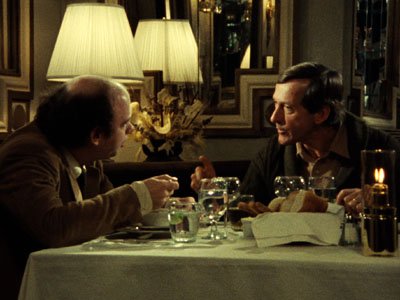
My Dinner With Andre ("You feel like you're sitting right there in the restaurant with them!")


28) Chris Evans or Ryan Reynolds?

I like Ryan Reynolds more than Chris Evans (that dude just got on my nerves in the Fantastic Four movies), but I am actually looking forward to Captain America more than Green Lantern.

29) Favorite relatively unknown supporting player, from either or both the classic and the modern era

Anytime Larry Hankin shows up in something, he always makes me smile.

30) Real-life movie location you most recently visited or saw

A few summers ago I got a chance to visit the Timberline Lodge at Mt. Hood in Oregon... otherwise known as the shooting location for the exteriors shots of the Overlook Hotel in The Shining.


31) Second favorite Budd Boetticher movie

I don't know who that is.

32) Mara Corday or Julie Adams?

I don't know who they are either (Man, this is getting embarrassing!)

33) Favorite Universal-International western

"Doesn't the fact that it's universal make it international?"

34) What's the biggest "gimmick" that's drawn you out to see a movie?

The trailer for the Will Smith vehicle Seven Pounds intrigued me because it was one of those exceptionally rare trailers that didn't reveal what the movie was actually about. That got me in the theater.

35) Favorite actress of the silent era

I'm going to be completely unoriginal here and say Lillian Gish. I watched another one of her films not too long ago and that girl just had one of the most beautifully expressive faces I've ever seen. Period.


36) Best Eugene Pallette performance

That's funny because I was JUST watching The Adventures of Robin Hood the other day and remarking how much I loved Pallette's Friar Tuck.

37) Best/worst remake of the 21st century so far?

For the best I'm going to have to go with True Grit. For the worst, and I am saying this only because I was recently reminded of it, probably Around the World in 80 Days.

38) What could multiplex owners do right now to improve the theatrical viewing experience for moviegoers? What could moviegoers do?

Multiplex owners could lower their prices drastically an moviegoers could actually turn off their freakin' cell phones. However, I know neither of these are going to happen, so onward and upward.

Tuesday, May 24, 2011

When a Star Went Swingin' and Landed With a Thud


The following is an article I wrote for the blog Edward Copeland on Film (for which I am a regular contributor) commemorating the 20th anniversary of the release of Hudson Hawk. I also have to credit my fried Ed for coming up with the great title to this piece.


Once in a blue moon, Hollywood releases a movie which, in spite of its huge expectations, fails on such a massive scale that its name becomes indelibly associated with the word “flop” forever after. Films such as Ishtar, Heaven’s Gate, 1941, Howard the Duck, North, Battlefield Earth and Gigli are all notoriously remembered for how embarrassingly they tanked at the box office, how universally they angered critics and how completely they alienated audiences that they have achieved a level of immortality no less enduring than their more acclaimed counterparts (such as Casablanca, Gone With the Wind, Citizen Kane, Star Wars and The Godfather). Well, on this day in the summer of 1991, while Ridley Scott was unveiling Thelma & Louise to critical and financial success, Tri-Star Pictures was releasing another film by the name of Hudson Hawk to theaters and it quickly joined the very exclusive club of infamous box office bombs. For those who have neither seen nor heard of this film, here is a brief description of what it is, how it came to be and why we are still talking about it 20 years later.

Hudson Hawk was the brainchild of Bruce Willis, who in 1991 was at the peak of his popularity. The recently cancelled television show Moonlighting had turned him into a star but the 1988 blockbuster Die Hard (and its equally profitable 1990 sequel) firmly established him as a major box office draw and gave him the kind of clout he needed to produce his own vanity project. As it turns out, for years Willis had been developing a story involving a cat burglar in which he would play the title role. With his action flick-producing buddy Joel Silver footing the bill, Heathers director Michael Lehmann on board to give the film a subversive sensibility, and a hand-picked cast (including Danny Aiello, James Coburn, Andie MacDowell and many more) what could possibly go wrong? Well, as it turned out, everything. The film was plagued with all sorts of problems (many of which are chronicled in Richard E. Grant’s book With Nails) including cost overruns, cast replacements, location difficulties and creative tensions. Although these things were well covered in the press and no doubt helped contribute to the perception that the film was in trouble long before its release, it seems no amount of bad backstage buzz could’ve prepared anyone for what Hawk was actually trying to sell audiences.


I vividly remember looking forward to the movie myself. It was the summer before my sophomore year in high school. I was (and, quite honestly, still am) a big Bruce Willis fan, I was (and, once again, still am) a lover of action/caper movies and the trailers made this one look fun and exciting. My father was planning to take me one afternoon to see it but through a series of mishaps it just didn’t happen. As a fluke, he ended up going with a friend of his soon thereafter and he, to put it bluntly, hated it. Absolutely hated it. He hated it so much that he, knowing how much I wanted to see it, actually felt bad for me and tried to inform me with the utmost delicacy how truly awful it was. I had never, up to that point, seen my dad have such a visceral hostile reaction to a film (though I’ve seen it since). Naturally, I was heartbroken and didn’t end up viewing it until much later when it came to video. I admit I was certainly disappointed by it, but did not think it was quite as bad as I’d heard. It’s actually taken two decades and dozens more viewings for me to formulate a coherent final opinion on it. First of all, while I can admit to having some affection for it and actually enjoying watching it once in a while (Hudson Hawk is one of the few films I consider a genuine “guilty pleasure”), I can simultaneously admit to what a colossal miscalculation it is. The film is indeed bad, but it's bad in such a uniquely strange and jaw-droppingly surreal way that it’s actually hard to put into words what makes it so (although if you're looking for a very extensive analysis of what's wrong with the film, try this scene-by-scene critique at the Agony Booth).

Bruce Willis plays Eddie Hawkins (aka the "Hudson Hawk"), a smarmy, self-satisfied thief — presumably the best in the world — who, after being released from a 10-year stint in prison, tries to go straight but ends up getting blackmailed (though he really doesn’t put up much of a fight) into stealing again. Who precisely is blackmailing him can be confusing as there are far too many villains in the film. These include a psychotic billionaire married couple (the incessantly annoying Richard E. Grant and Sandra Bernhard) and their lethal British butler, four rogue CIA agents named after candy bars (yes, you read that right) and their arrogant leader (gamely played by James Coburn), two Italian mobsters called (sigh) the Mario brothers, a corrupt parole officer, a pair of silent twins and a deadly little dog named Bunny. Furthermore, what Hawk is stealing and why he's stealing it also is somewhat confusing as the plot for Hudson Hawk is so convoluted it's virtually incomprehensible. Suffice it to say, it involves some art treasures of Leonardo DaVinci, a giant machine that can turn lead into gold and a top-secret Vatican organization.


The plot is ultimately unimportant because Hudson Hawk was clearly conceived as a series of comic-action set pieces. Some of them are admittedly unique and memorable (such as an ambulance and hospital gurney chase across the Brooklyn Bridge), but many of them, unfortunately, are outlandishly bizarre and embarrassingly grotesque. It has the feel of a movie where every single idea was considered clever and thrown into the pot while nobody bothered to ask "Hey, are we going too far here? I mean, does any of this make any sense?" For example, one particularly absurd, yet admittedly amusing, conceit is that Hawk and his partner Tommy (the always charismatic Danny Aiello) time their heists by singing songs to which they each know the exact running length. The end result is an honest-to-God musical number wherein two burglars are crooning Bing Crosby's "Swingin' On a Star" while cracking safes and dodging guards. Besides being an utterly ridiculous concept for a variety of reasons (it's an imperfect way to time something given that songs can be sung at different tempos or it can actually be rather noisy when silence might be the best approach to performing a robbery, etc), it's just another example of the wildly inconsistent tone that the film has. One second the characters are belting out showtunes, the next second they're in a thrilling action sequence. In one scene they're involved in a wacky bit of physical comedy, the next they're witnessing a rather ugly act of brutal violence.

Alas, much of the blame has to be directed at Willis himself as many of its flaws clearly originate in the conception stage and Hudson Hawk was his baby from beginning to end. Willis seemed to want the film to be a very specific thing and his ego just got the better of him. This is just speculation on my part, but I suspect Willis was probably spoiled by his experience on Moonlighting, a show that successfully played with the conventions of television (constantly breaking the fourth wall, throwing gags at the audience at lightning speed, etc.) while still telling stories that engaged viewers emotionally. Willis probably thought he could bring the same zany, anarchic spirit to the big screen with a satirical take on action movies that still retained the thrill that great stunt sequences can provide (Joel Silver, John McTiernan and Arnold Schwarzenegger would attempt a similar feat two summers later with Last Action Hero with about the same level of success) and the end result is a rather schizophrenic picture that just can't seem to decide what kind of movie it truly is ("Is it an action-thriller? Is it a comedy-spoof? Is it a musical?") or who it's intended audience would be. ("Who's this for? It's too silly and cartoonish for adults yet too violent and vulgar for kids.")


Willis' career managed to recover from the debacle of Hudson Hawk, but he continues to defend the film to this day (as do the members of its small cult following). It's always interesting to hear filmmakers attribute a film's poor reception to audiences not "getting" their film. On the Hudson Hawk DVD commentary, for example, director Michael Lehmann talks about how the film was not well-received because people, based on the film's advertising, were not expecting a comedy. While this is certainly true, it never seems to occur to Lehmann or Willis that perhaps they also just made a bad movie. Speaking for myself, I think I "get" what they were trying to do. I'm just not sure that what they were trying to do was such a good idea. Yes, I know they were poking fun at the cliches of action movies and deliberately twisting the conventions of the cinematic language (such as changing the time from day to night in the middle of a scene), but those conventions exist for a reason and if you knowingly violate them then you run the risk of confounding your audience who need such conventions to orient themselves to what they're seeing. If, for example, you have a character fall from an enormous height and simply walk away unharmed (or, as in the case of this film, survive an explosion in the back of a car because a sprinkler system was installed), then you remove any element of the threat of danger from your equation. Thus, with nothing at stake there's no suspense and with no suspense there's no emotional investment on the part of the audience. They had to know this was at least a possibility when they decided to break these rules. Either they didn't know or they just didn't care and it's that kind of blatant disregard for logic and sense that got their film trashed. A lot of Hollywood movies require us to suspend disbelief. A lot even ask us to accept nonsense as if it were sense, but very few expect us to accept nonsense simply because it is nonsense. They must have either been giving audiences too much credit or not nearly enough.

So, what's my verdict on Hudson Hawk? Well, despite the fact that the film does possess some stellar elements (such as the gorgeous production design by Jackson DeGovia, the striking cinematography by Dante Spinotti and the wonderful music score by the late great Michael Kamen) and a few truly funny moments that can't help but make me laugh (I get a kick out of the gag where the Italian night watchman pours spaghetti out of his thermos instead of coffee), I mostly enjoy Hudson Hawk precisely for its sheer brazenness in flaunting the well-known and well-established rules of visual storytelling. On those rare occasions when I do watch it, I always wear a big goofy grin on my face as I simultaneously shake my head in disbelief. Twenty years later, Hudson Hawk is perhaps the best "worst movie" I've ever seen and one of the most perfect examples Hollywood has ever produced of how NOT to make a film.

Friday, March 11, 2011

"You Have Nowhere To Go."


The following is an article I wrote for the blog Edward Copeland on Film (for which I am a regular contributor) commemorating the 40th anniversary of the release of THX-1138.

Forty years ago today a flawed but fascinating sci-fi film called THX-1138 was released by Warner Bros. to nonexistent box office and negative reviews. Perhaps its poor reception was due to the fact that the studio did not really care for the picture and consequently did not give it a big publicity push. Perhaps it was because the film itself was so strange, so stylized and so cerebral that it confused and thus alienated audiences. Even now it still hasn't been widely seen and enjoys, at best, a limited cult status. So, why are we commemorating the 40th anniversary of a relatively obscure and nearly forgotten sci-fi flop? Simple.

Its director was the 27-year-old George Lucas.

It's easy to forget that there was a time before George Lucas became so obscenely loved for dreaming up the "galaxy of far, far away" — and then subsequently became equally loathed for "sullying" that galaxy with some vastly inferior prequels — but it's true. Years prior to Lucas' reaping of untold fame and fortune from his entertaining space opera, he was just another up-and-coming filmmaker trying to create work that would set him apart from the crowd. While at USC he produced an intriguing live-action short film called Electronic Labyrinth: THX-1138 4EB that seemed to accomplish that very thing. The film depicted a solitary individual, with a number tattooed on his forehead, racing through various dark tunnels and passageways as he attempts to flee his oppressive society, who in turn monitor his movements and try to foil his escape. Garnering awards at various film festivals, Lucas' brainchild caught the attention of studio executives and led to a feature film adaptation produced by his friend Francis Ford Coppola's production company American Zoetrope. With a slightly bigger budget and actors of the caliber of Robert Duvall and Donald Pleasance, how could Lucas go wrong?


Before discussing the film I must confess to never having seen the original theatrical cut of THX-1138. The only version I've seen is the 2004 DVD version which includes what has now become Lucas' trademark: retro-fitted digital imagery to help bring the film closer to his "original vision." Although I am adamantly against this indulgent practice (particularly when the filmmaker, in an attempt to rewrite film history, makes the original version no longer available), my ignorance of the film's original state helped make the "improvements" not nearly as bothersome to me. As with the alterations made to the Star Wars movies, the changes here are primarily cosmetic in nature. Granted, there were two or three moments that completely took me out of the film because they stuck out like sore thumbs (particularly the addition of a brief CGI car chase that precedes the film's original climax), but unless someone is intimately familiar with the 1971 version, it is unlikely they are going to cringe with the frequency that I did viewing the so-called "special editions" of the Star Wars movies. Incidentally, for a more in-depth comparison of the differences between the two you can read about it here or view a short video here.

The story of THX-1138 is a rather simple one. In the underground society of a dystopian future, individuality is suppressed (as manifested by the fact that everyone wears the same outfit and has their heads shaved bald), emotions are dulled through the use of narcotics, conformity is mandated and its citizens have been all but stripped of their humanity (as evidenced by the fact that peoples names consist of a seemingly random sampling of letters and numbers). Robert Duvall plays THX-1138, an ordinary factory worker whose "mate" LUH-3417 (Maggie McOmie) rebelliously decides to stop taking her drugs and even gets him to do the same (interestingly, the motivation behind her decision is never made clear and thus is a little unsatisfying; in the similarly-themed Equilibrium, Christian Bale accidentally drops his pills down the drain and only after he begins to feel the effects chooses to remain off them). When THX starts to have intense emotions — including sexual desire for his partner — for the first time, he is captured and imprisoned by the state but eventually manages to escape and, in a third act that most closely resembles Lucas' original short, makes his way to the surface.


There is no denying the power of many of the images seen in THX-1138. Certain moments feel incredibly surreal and yet are portrayed as being frighteningly mundane. Robot police officers (precursors to C-3PO and stormtroopers) beating humans with sticks for entertainment, people expressing their guilt to a detached electronic deity in weird "confessional-like" chambers, etc. Co-writer Walter Murch has said that his and Lucas' intent was not to create a movie ABOUT the future but rather FROM the future. Thus, many things are left unexplained and are treated just as if their existence is normal and accepted. This is what makes the film unique and yet probably turned off audiences in 1971. One can get lost trying to understand all of the technical jargon heard in the dialogue and is often left scratching one's head as to what a particular object in any given scene is. Personally speaking, I was left most confused as to whether the "hologram" SRT (played by Don Pedro Colley) that THX encounters in the white prison was an actual hologram who somehow found a way to come into existence or simply the human actor that was used to create the hologram. The movie never explains this and it betrays, I think, Lucas' tendency to gravitate more toward symbolism and allegory than verisimilitude in storytelling. Inevitably, I concluded that the best way to enjoy the film was to simply surrender to the world Lucas has created...and what a world it is.

Lucas manages to fashion an environment that is simultaneously immense and claustrophobic. In a way it is just as detailed and involving as any of those seen in the Star Wars movies, yet colder, bleaker and more bizarre. This is a place that seems just as real and believable as Tatooine, Hoth or Endor but it is not a place in which you would want to actually spend any time. In fact, it's a world so endlessly fascinating and complex that it is somewhat of a shame that the movie doesn't find some other way to resolve it than with a a simple car chase (one can feel Lucas' love of racing vehicles emerging from the film's climax). Maybe this was an attempt on the part of the studio to inject some excitement into what was, after all, supposed to be just another Hollywood product. Maybe it was Lucas' attempt to retain the visceral spirit of his original short film. I don't know. Nevertheless, in spite of its lofty ambitions, in the end THX-1138 still tries to come out an entertaining "popcorn" movie and it's a little disappointing. It would be as if Kubrick had decided to throw an epic Moonraker-esque space battle at the end of 2001. To that end, Lucas would make a much more consistent product six years later. Though not nearly as esoteric and intellectual as THX-1138, Star Wars at least wore its intentions on its sleeve and ended up being a less schizophrenic finished product.


It is interesting to view THX-1138 now with the knowledge of what Lucas would later become. Some have reveled in the apparent irony that at one time Lucas was the equivalent of the Robert Duvall character and yet has now become the incarnation of the powerful, evil establishment that oppressed him. Whatever you think or feel about Lucas, his first feature film, while not great (as far as cinematic representations of nightmarish Orwellian futures go, I prefer Terry Gilliam's Brazil), is still pretty good and definitely worth seeing...if for no other reason, than to witness the sheer potential exhibited by its writer-director. It was a potential that would only later be fully realized. Unlike the voice that informs Duvall that he cannot escape, that he has "nowhere to go," George Lucas clearly did have somewhere to go.

Sunday, February 13, 2011

The Blood is Still the Life


The following is an article I wrote for the blog Edward Copeland on Film (for which I am a regular contributor) commemorating the 80th anniversary of the release of Dracula.


They may be cold to the touch, but right now vampires are pretty hot. Shows such as Vampire Diaries and True Blood, movies such as Let the Right One In and its American remake Let Me In, books such as the Twilight series (and its accompanying movie adaptations) and even a whole subculture of teenage "vampire-wannabes" serve as constant reminders to us that vampires currently are a very popular cultural phenomenon. Yet, in their various literary, movie and TV incarnations, vampires mostly are portrayed as tortured, sensitive souls cursed to continue their earthly existence through the blood sacrifice of others. I'm not entirely sure when this shift toward conceiving of vampires as sympathetic took place but I think it owes a great deal to the novels Anne Rice wrote in the '70s and '80s. Before romantic, melancholy characters like Lestat and Louis came along, vampires were seen (like werewolves, mummies and Frankenstein) primarily as monsters. They were evil, bloodthirsty beings who actually enjoyed taking the lives of others in order to survive. Almost nowhere is this is more apparent than in Tod Browning's 1931 Dracula, which celebrates its 80th anniversary today. In looking back at this horror classic, one recognizes many of the very qualities that would come to be rejected by modern-day vampire enthusiasts while simultaneously seeing several of the very aspects that entrance them with that whole dark underworld in the first place.

Browning's was not the first cinematic treatment of Bram Stoker's novel. Despite being unable to secure the rights, the great F.W. Murnau adapted it into his 1922 silent Nosferatu and was subsequently sued by Stoker's widow. Murnau's Count Orlock (sinisterly played by German actor Max Schreck in a lot of make-up) was a repulsive creature whose evil was manifested in his hideous appearance which, incidentally, more closely resembles the character described in the original book. Browning's Dracula, on the other hand, is all too human. Played by the Hungarian actor Bela Lugosi (who originated the role in a successful Broadway play written by Hamilton Deane and John L. Balderston), he's handsome, charming, poised, well-dressed, well-groomed and rather sexy. It is this version of the character that most influenced the way the public perceived vampires and Lugosi's Central European elegance and flair played a big part in that.


Though it seems somewhat campy today, Lugosi's performance is iconic and captivated people's imagination at the time. He brought a theatricality to the role that helped to establish vampires as larger-than-life beings who walk, practically glide, untouched through the world of mortals. As Roger Ebert once wrote, "Vampires are always in pose mode... The buried message of many scenes is: Regard me well, for here I am, and I am thus." Speaking in a broken English accent (which, contrary to legend, did not indicate that Lugosi had to learn his lines phonetically; by the time the film was made he spoke English very well), Lugosi welcomes an unsuspecting Renfield — played with equal theatricality by Dwight Frye — into his castle like "a spider spinning his web for the unwary fly." His lines, mostly absent from the original book, are spoken in such a slow, deliberate manner that they have become just as famous for their delivery as for their words: "I never drink... wine," "Listen to them: children of the night. What music they make," and the simple yet hypnotic introduction, "I am... Dracula."

The Deane/Balderston play served as the basis both for the interpretation of the Dracula character and for the structure/aesthetic of the rest of the film. This is why, after a spectacular opening in Dracula's Transylvanian castle, the film takes place mostly in England and takes on the feel of a typical "drawing room" mystery. Browning's approach to the look of the film is appropriately dark and moody but not especially inspired. It has been speculated that the passing of Browning's original choice for the role of Dracula, his friend Lon Chaney, so upset him that he didn't invest as much effort and care into the production as he otherwise would have and in fact left it to cinematographer Karl Freund to do most of he shooting. Interestingly, the crew that filmed the Spanish-language version of Dracula (since it was common practice at that time for studios to make a completely different film utilizing the same sets and costumes rather than simply dub the existing film with foreign languages) created a far more visually interesting product with more camera movement, better staging of certain sequences and even some special effects that made the English version seem a little hokey. What it didn't have, however, was a Dracula with the charisma and screen presence of Bela Lugosi.


There is another element that to modern audiences is noticeably absent from the film. Outside of the opening titles (where Tchaikovsky's "Swan Lake" can be heard) and a scene in a concert hall, the film is completely devoid of any music. Dracula was one of Browning's first sound pictures and his discomfort with the new technology seems apparent in his use of sound. There are long stretches of silence in the which, though they invoke an atmosphere of suspense and dread, clearly reflect a filmmaker whose training stems from silent cinema. Esteemed minimalist composer Philip Glass attempted to rectify this in 1998 by writing a score for a string quartet that he intended to accompany the film and indeed most DVD versions now have the option of viewing it with a separate audio track that includes Glass' contribution. Although Glass is undeniably talented and the score is itself worth listening to, I personally find it too distracting and intrusive. It transforms Dracula from a piece with perhaps too many silent moments to a film with practically no silent moments. Thus, whenever I sit down to watch it (which usually is every Halloween) I have to do so without Glass' music to really enjoy the experience.

It might be hard now to imagine that anyone ever thought Dracula was scary, but the truth is that people were frightened by what they saw. Decades before newspapers would report that The Exorcist had patrons fainting in the theaters, Dracula had a similar effect on audiences and, to the delight of the studio, it was an enormous box office success. Looked at today a lot of it seems amusing at best and rather silly at worst, but several things save it from being simply a relic of a bygone era: Freund's striking cinematography, some magnificent sets, a few genuinely creepy moments and memorable performances by Dwight Frye, Edward Van Sloan (as Van Helsing) and, of course, Bela Lugosi (who would become so identified with the role that he would have a lifelong love/hate relationship with it). What also cannot be ignored is the role it played in initiating a whole pantheon of cinematic vampires that would later follow. Just as Bram Stoker's book coalesced and solidified much of the language and imagery that is now associated with the mythology of vampires, Tod Browning's Dracula would establish much of what makes vampires attractive to a moviegoing audience: their mystery, their immortality, their sex appeal. They may have started out as engaging villains and ended up as angst-ridden antiheroes, but regardless of how they got that way, without the work of Browning and Lugosi, we wouldn't have any of the vampire media that we do today... though we shouldn't blame it for that.