Monday, October 31, 2011

Paradise Lost


The following is an article I wrote for the blog Edward Copeland on Film (for which I am a regular contributor) commemorating the 25th anniversary of the release of The Mission.


"All that is necessary for evil to triumph is for good men to do nothing."


An elderly Catholic cardinal stares intensely at us, his hard facial features betraying an expression of complete ambiguity. Is he angry? Sad? Afraid? We don't know. After several seconds he begins to speak. He is dictating a letter to the pope, relaying details of a past event which the film proceeds to show in flashback. His narration explains how Jesuit priests, who set up missions in South America for the education and protection of the local natives, journeyed into the depths of the jungle "to bring the word of God to those Indians still living in their natural state and received in return, martyrdom." We then see one such cleric, stripped to the waist and wearing a makeshift crown of thorns on his brow, being tied to a wooden cross and carried by a group of these Indians (whom we later learn are called the Guarani) down to a river where he is thrown in. He floats away silently, still alive but seemingly resigned to his fate. We watch as he travels further downstream, a grotesque living crucifix adrift in a series of rough rapids, before sailing over the edge of an immense waterfall and plummeting to his death. Thus opens the breathtakingly beautiful and tremendously powerful historical drama The Mission (which celebrates its 25th anniversary today), one of the finest films I personally have ever seen.

Based on actual events that occurred in the territory that borders Paraguay, Brazil and Argentina in the mid-18th century (and, knowing Hollywood's track record for distorting history, no doubt embellishing it), The Mission primarily tells the story of two very different, and yet remarkably similar, men. The first is Father Gabriel (Jeremy Irons), a kind, noble and patient Jesuit priest who, after the death of his friend, decides to bravely enter the domain of the Guarani tribe. In one of many memorable and visually spectacular sequences, Father Gabriel climbs up the waterfall from the film's prologue, slipping and almost plunging to his own death in the process. His conquering of the falls is the first of many obstacles he must overcome in his quest to finish what his unlucky colleague began.

In a subsequent scene, Gabriel sits calmly on a rock and plays a sweet but elegiac little tune on his oboe as Guarani begin to slowly surround him with their weapons drawn. Though he notices them approach, he continues to play on, his face clearly betraying fear and yet his will proving strong and resolute. Suddenly one native shouts at him angrily, grabs the oboe, breaks it in two across his own knee and storms off. Another one picks up the pieces, examines the instrument as if trying to understand how such a lovely sound could come from it and meekly offers it back to Gabriel who tries to fix it before shaking his head. The native then takes Gabriel's hand and with the consent of everyone else present leads him back to their home. It is a phenomenal dialogue-free sequence about the universal allure of music and the kind of respect that can exist across vast ethnic, cultural and linguistic barriers. In courageously refusing not to be intimidated by these dangerous "savages" as well as not responding with anger or hostility to their destruction of his beloved property, Gabriel begins the first step in earning the trust and admiration of these understandably scared and suspicious people.

Gabriel begins to establish a mission named San Carlos in the heart of the jungle, a sanctuary where the Guarani can hear the Gospel and also be safe from the brutality of the slave traders who capture (and sometimes kill) them. It is here that the film introduces its other primary character: a mercenary named Captain Rodrigo Mendoza (Robert De Niro) who is so notoriously ruthless that when he encounters father Gabriel in one of his many hunting excursions, Gabriel's assertion that they are "building a mission here to make Christians of these people" is met with the callous response, "If you have the time." However, when Mendoza discovers his younger brother Felipe (Aidan Quinn) in bed with his own fiancee, he angrily kills Felipe in a duel and, unlike his spiritual ancestor Cain, immediately regrets his fratricide afterward. Although the law can't touch him, Mendoza is consumed with guilt and punishes himself by wasting away in a cell refusing to eat or speak to anyone. Into his misery comes none other than Father Gabriel who, in a manner very similar to his initial encounter with the Guarani, bravely confronts Mendoza for the coward that he is (not only refusing to be intimidated by his threats but actually daring him to act on them) and offers him a chance at redemption. "For me there is no redemption," Mendoza laments. "There is no penance hard enough for me." Gabriel asks: "But do you dare try it?" to which Mendoza replies: "Do you dare to see it fail?"

What follows is another magnificent extended sequence wherein Mendoza accompanies Gabriel and a few other members of his order back into the jungle all the while dragging behind him a huge bundle of metallic weaponry (swords, shields, armor, etc) at the end of a rope. It even involves climbing the same waterfall (which becomes a sort of character in itself) Gabriel did. It all culminates in another dialogue-free scene of almost immeasurable emotion and profundity; indeed it's one of the most moving depictions of forgiveness I've ever seen on film (although there is a comparable one in Terrence Malick's latest opus The Tree of Life). Mendoza soon becomes an active part of the seemingly idyllic existence at San Carlos. Grateful for his "second chance" at life, he asks Father Gabriel what he can do in return. Gabriel hands him a Bible and we see Mendoza reading passages from the apostle Paul's first letter to the Corinthians ("Though I have all faith, so that I could remove mountains, and have not love, I am nothing. And though I bestow all my goods to feed the poor, and though I give my body to be burned, and have not love, it profiteth me nothing. Love suffereth long, and is kind; love envieth not; love vaunteth not itself, is not puffed up…But now abideth faith, hope, love, these three; but the greatest of these is love."). Indeed, much like Paul, who persecuted Christians only to become one of their greatest proponents, Mendoza transforms from a murderer and trader of the Guarani into their friend and advocate.

Having witnessed enough death in his life Mendoza swears off all violence (as is seen in a sequence where the Guarani invite him to help slay a boar they've hunted and he refuses) and even joins Gabriel's order vowing to protect and serve his fellow man. This, however, proves very difficult as the signing of the Treaty of Madrid reallocates the previously protected lands inhabited by the Jesuit missions to Portugal, which unlike Spain permits slavery. This leads to the section of the film where Cardinal Altamirano (Ray McAnally), the stoic priest who narrates the film, is sent by the pope to appraise the Jesuit missions and decide whether they should continue to fall under the protection of the Roman Catholic Church. In some emotionally charged scenes (where the disparity between good and evil is rarely so starkly drawn), the Jesuits defend the humanity of the Guarani and the virtues of the missions while the plantation owners assert the inferiority and animal-like natures of the Guarani and apply political pressure to Altamirano for a favorable decision. They are such despicable, sorry excuses for human beings that it actually borders on the comical.

Unfortunately, even after visiting the San Carlos mission and seeing the "paradise on earth" that the Jesuits and the Guarani have built together, Altamirano comes to the inevitable conclusion that in order to save the whole body (the body in this case presumably being the "body of Christ," or the church) one must sometimes hack off a limb (the limb being the missions), not unlike another pragmatic religious leader named Caiaphas who determined centuries earlier that it is "better that one man should die for the people than that the whole nation should perish." He tells the Guarani that they must leave the mission, but they do not want to leave. It is their home. When they question the wisdom and authority of this priest, he asserts that they must learn to submit to the will of God. Confused, the Guarani say that it was the will of God that they came out of the jungle and built the mission and they don't understand why God has changed his mind. The Guarani decide to stay and fight. Altamirano tells the Jesuits that they must not fight with the Guarani but that they must instead return to Rome with him. Angry at this betrayal by the church, Mendoza literally takes up his sword again and, along with several other Jesuits (including a young Liam Neeson), joins with the Guranai in defending their home against the colonialists.

The only one who doesn't take up arms is Father Gabriel. Heartbroken at this turn of events, but still unwilling to abandon the Guarani to their doom, Gabriel chooses to stay with them, but he will not kill. On the eve of the impending battle, Mendoza comes to Gabriel to be blessed for his efforts, but Gabriel refuses to do so. "If you're right, you'll have God's blessing," he says. "If you're not, my blessing won't mean anything." The two men embrace and the climactic final showdown soon follows. Alas, the outcome is hardly unpredictable. Nearly all of the Guranai who resist are slaughtered. Mendoza and the other priests are killed in battle. Father Gabriel, who stages a nonviolent demonstration with many of the Guarani women and children, also is killed and his mission is burned to the ground.

Shortly thereafter, Altamirano is seen eating with the plantation owners and he is utterly sickened not only by the news of this massive loss of human life but by their ambivalence to it. "And you have the effrontery to tell me that this slaughter was necessary?" he asks. Calmly and coldly, they tell him that they believe it was. "We must work in the world, your eminence," one of them says. "The world is thus." To this Altamirano replies, "No, Señor Hontar. Thus have we made the world," before gazing out the window and somberly admitting his own culpability in the affair. "Thus have I made it." The film concludes with Altamirano finishing his letter to the pope and, in one of my favorite post-credit movie codas (right up there with Ferris Bueller's Day Off and Young Sherlock Holmes), stares intensely back into the camera as he did in the film's opening image.

The Mission was written by Tony Award-winning playwright (A Man for All Seasons) and two-time Oscar-winning screenwriter Robert Bolt (Doctor Zhivago and A Man for All Seasons), whose credits also include other historical epics with decidedly intimate focal points such as Lawrence of Arabia and The Bounty. The Mission was directed by the English filmmaker Roland Joffé, whose only prior feature film, The Killing Fields, won him much critical acclaim and seemed to signal the promise of a great director. Unfortunately, his career since The Mission has been notably unimpressive, with his failures (such as Super Mario Bros., The Scarlet Letter and Captivity) looming much larger than his successes. Nonetheless, in spite of its flaws, The Mission is an extraordinarily compelling piece of work with many superlative elements to recommend it. The performances are uniformly solid but Jeremy Irons and Robert De Niro are especially good. The spiritual journeys of these two men are the real heart of the film and both actors imbue their parts with subtlety and soul. De Niro's reticent warrior is perhaps a bit more complex, but Irons' faithful Father Gabriel is no less interesting or sympathetic.

One of the things I love about The Mission is how it doesn't cast its lot with either character at the film's finale. Both men are clearly trying to do the right thing in an otherwise awful situation and even though they disagree as to what that is, the film doesn't judge the actions of either. The film also boasts some gorgeous locales beautifully rendered by cinematographer Chris Menges (who won an Academy Award for his efforts) and the highly evocative film score by legendary Italian composer Ennio Morricone not only stands out as one of his best works but has become one of the most popular soundtracks around…even for those who don't typically notice/collect film music. The piece "On Earth as it is Heaven" (the tune played by Gabriel on his oboe early in the film) is a bittersweet melody that haunts much of the film's imagery and the celebratory choral "Guarani" theme (made up of exotic instruments and native-style chanting) lingers in the memory long after the film is over.

Although it received a handful of awards (including the prestigious Palme d'Or at Cannes) and numerous other nominations, The Mission was lukewarmly received when it was released in 1986. Nobody panned it but few critics praised it as a masterpiece either. Most labeled it merely mediocre and remained rather indifferent to it. Roger Ebert wrote that it felt "exactly like one of those movies where you'd rather see the documentary about how the movie was made" (incidentally, the DVD and Blu-ray release of The Mission includes the hour-long doc Omnibus, which chronicles the making of the film in case he, or anyone else, ever wants to actually do that; I have and although it is fascinating, I still prefer the film itself). Considered by many to be muddled, ponderous, pious and with characters who seemed more like "types" than fleshed-out human beings, it grossed a meager $17 million at the box office and faded into relative obscurity thereafter. Over the years, however, as more and more people have discovered this little-known treasure of a film, it has gained a somewhat more prominent reputation …particularly among religious folk who are drawn to its themes of redemption, forgiveness, faith, courage, love, compassion, goodness, evangelism, etc. In fact, the weekly Anglican publication Church Times picked it as No. 1 on a list of the "Top 50 Religious Films" and in 2004 Arts & Faith ranked it No. 54 on their "Top 100 Spiritually Significant Films."

Speaking only for myself, I find it to be an incredibly deep and thoughtful piece of work; indeed one of my favorite films. In the interests of full disclosure though, I should probably make it known that I am myself a Christian (though I don't belong to any particular denomination) and as such tend to respond favorably to stories that involve people who share my faith and the struggles that they deal with as they attempt to live it out. Many people already now this about me, but it's still a little nerve-wracking to admit that about myself because I realize it is not a popular thing to be right now. There are a lot of Christians out there who are making a lot of noise (as well as a lot of enemies) and as such people tend to lump us all in the same category.

As I believe Dr. Peter E. Dans observes in his book Christians in Movies: A Century of Saints and Sinners, it is becoming more and more difficult to find positive portrayals of Christians in movies and TV and far more commonplace to see them depicted as sanctimonious, hypocritical, judgmental, right-wing ignoramuses (see movies such as Paul, Footloose and Easy A as well as TV shows such as 30 Rock, The Big Bang Theory and The Office). Consequently, a film such as The Mission, where the church may not come off particularly well but individual believers are depicted quite sympathetically, resonates with me simply because it goes against the recent trend.

I'd like to think, however, that I can still be objective enough to recognize a good movie (which I think The Mission is) when I see one, whether it tends to paint Christians in a good light or not. I am not particularly interested, for example, in so-called "Christian" movies, partially because they are essentially works of propaganda and I tend to respond to all propaganda the same (whether it propagates something I happen to agree with or not), but also because they tend to be as many critics (including this one and this one) have pointed out, pretty bad. Nonetheless, there are some films that I think could be classified as "Christian" (though I personally don't even really consider that a viable category) that don't fit the usual "faith-based" mold we have come to expect and which I think are far more powerful, existential and artistic (films such as Shadowlands, Chariots of Fire, The Exorcist, Dogma, Chocolat, etc). I think The Mission belongs with those films. It might not be a "Christian movie" per se (whatever that is) but it is a movie about Christianity and its admittedly checkered past (I am not naive enough to think that the real-life missions were as idyllic as they are depicted here) and it appropriates into its worldview many of the truths about life and human nature that draw me to the Christian ideology.

Friday, September 23, 2011

Trust him. He knows what he's doing.


The following is an article I wrote for the blog Edward Copeland on Film (for which I am a regular contributor) commemorating the 25th anniversary of the premiere of Sledge Hammer!.


"If all you have is a hammer, every problem begins to look like a nail."


Cop shows are a dime a dozen. For as long as the medium of television has existed there have been cop shows. Consequently, in such an overcrowded genre, which includes such distinguished icons as Dragnet, Adam-12 and Hill Street Blues, it is very difficult for a new one to make a distinct impression on viewers let alone leave any kind of legacy. Thus, in a bold attempt to be different, some producers have had the brilliant idea of doing a comic cop show, but prior to Reno 911, those programs proved to be television poison. Car 54, Where Are You?, Cop Rock and Police Squad! all had notoriously brief runs (although the latter would spawn a very successful comedy movie franchise). Alas, the same fate also befell the satirical 1980s sitcom Sledge Hammer! Despite critical acclaim, Hammer! was consistently second-to-last in the Nielsen ratings and after running only two seasons was unceremoniously canceled. Like its “comic-cop” brethren, Hammer! has developed a cult following over the years but unlike its “comic-cop” brethren, Hammer! has aged remarkably well. In fact, watching it 25 years later it is painfully clear that Sledge Hammer! was, as the saying goes, way ahead of its time.

Needless to say, without Dirty Harry there would be no Sledge Hammer!. In 1971, 16-year-old Alan Spencer saw the iconic Clint Eastwood film and was very affected by it. While the movie was inciting heated debate over whether its portrayal of a gung-ho policeman more interested in protecting innocent people than following the law was fascistic, Spencer astutely grasped the absurd humor of the whole thing. He wrote a script that featured a central character with even less scruples and an even more destructive personality — sort of “Dirty Harry on acid” — and thus, Sledge Hammer was born. However, it would be many years before it reached the television screen. Originally intended for HBO, it was ABC that eventually took a chance on Hammer!. I wish I could report that risk paid off but, as actor David Rasche puts it, “it was not to be.”

I discovered Sledge Hammer! completely by accident. When it premiered on ABC in 1986 it initially followed a half-hour Disney show called Sidekicks (with Ernie Reyes, Jr., Gil Gerard and Keye Luke) that I wanted to watch because it was based on a Disney Sunday Movie I loved called The Last Electric Knight. At the time I thought it was great, but now I realize it was just another second-rate Karate Kid rip-off. However, I do owe the show a tremendous debt because if it weren’t for Sidekicks I wouldn’t have seen Sledge Hammer!. I remember watching the Sidekicks episode on the TV in my room and when it was over I decided to leave the set on rather than turn it off and go to bed. When the next show’s opening credits began I heard this very energetic, macho-sounding theme music (which I would later discover was written by an up-and-coming film music composer named Danny Elfman who would go on to become one of my all-time favorite musical talents) playing over close-up images of a .44 Magnum with an insignia of a sledge hammer imprinted on the handle. After several almost erotic-looking shots of the gun resting on a satin pillow a hand reaches into frame and holds it up next to his face staring at it longingly. He twirls it several times, points it slightly to the left of the camera and then says “Trust me. I know what I’m doing,” before firing it and making what was presumably supposed to be a hole in the television screen. Interestingly, the original idea was to have Hammer shoot directly into the camera Great Train Robbery-style, but the network was nervous it would frighten viewers and possibly even result in heart attacks. Hence, the slightly off-kilter direction of the gun’s barrel was agreed upon as a compromise. Incidentally, I‘d like to make a snarky remark here about television executives overestimating the stupidity of viewers, but I won’t because, according to IMDB, on the night of its debut a Midwest ABC affiliate was indeed “startled by the opening sequence, panicked and threw on the station logo thinking something had gone wrong with their tape machine.” It’s the kind of turn of the events that would fit right in with the absurd spirit of the show itself.

Sledge Hammer! was, as creator Alan Spencer aptly claimed, a “sitcom for people who hate sitcoms.” The main premise was apparently to take every cop show/movie cliché and exaggerate it to the point of absurdity. The humor ranged from pointed socio-political and commentary all the way to goofy, over-the-top slapstick. It essentially did for cop dramas what Get Smart (an admitted influence on Spencer) did for spy stories. It may have been dumb but it was dumb in a very intelligent way. It also was, and this is no small feat, side-splittingly funny. I remember liking it an awful lot when I was 10 but I was genuinely surprised, as I reviewed most of the episodes recently, how often I laughed out loud. Much of the hilarity came from the series’ central character, the sadistic, misogynistic, nihilistic San Francisco homicide detective. Born to parents Jack and Armen (think about it) Inspector Sledge Hammer was the kind of cop for whom excessive force was standard operating procedure, the kind of cop who would brag about violating a criminal’s civil rights, the kind of cop for whom the observation “he shoots first and ask questions later” was not a criticism but a compliment.

REPORTER: We're here at the scene of a liquor store robbery that was thwarted by the man beside me, Inspector Sledge Hammer. Inspector Hammer, tell us what happened.
HAMMER: Well, miss, I was in this store when two thugs entered and threatened the owner with shotguns. At that time, I drew my Magnum and killed them both. Then I bought some eggs, and some milk, and some of those little cocktail weenies.
REPORTER: Inspector Hammer, was what you did in that store absolutely necessary?
HAMMER: Oh, yes, I had no groceries at all.


Hammer’s main ally in his fight with crime (nay, his all-out full-scale global thermonuclear war on crime) was his beloved .44 Magnum. Hammer so adored that gun that he always had it with him. He showered with it, slept with it (and not under his pillow like James Bond, but resting comfortably on the pillow next to him…like a lover) and even talked to it. Yes, talked to it. Hammer was clearly unbalanced and yet still sane enough to realize that talking to one‘s firearm is considered strange. It’s a very funny running gag throughout the run of the series that every time he is caught conversing with his weapon, he would try to shrug it off or make some feeble excuse ("Who are you talking to?" "Uh, nobody."). In spite of his sheer disregard for any kind of human decency, compassion or etiquette, Hammer is a very engaging character. To that end, the charm and charisma of actor David Rasche (The Sentinel, Burn After Reading) goes a long way. Rasche fully commits to Hammer’s more disturbing personality traits without even attempting to soften any of his hard edges, but still manages to make him bizarrely likable. Rasche is truly a revelation in the role and it is no surprise to learn that Spencer wrote the part for him.

Supporting Rasche’s Hammer is the beautiful but tough Dori Doreau, played by the sexy and talented Anne-Marie Martin. In typical cop show/movie fashion, the crazy cop’s partner is very by-the-book. Though she is often distressed at Hammer’s antics, she nonetheless seems to like him. Martin essentially plays the straight man to Rasche’s anarchic antics (though she can be, and sometimes is, hysterically funny herself…especially in “Desperately Seeking Dori” were she gets hit on the head and believes she is Hammer herself). She’s the “99 to his Max.” Rounding out the solid cast is Harrison Page’s long-suffering Captain Trunk. Just as Chief Inspector Dreyfus was constantly irritated with Clouseau, so is Trunk forever upset with Hammer, always reprimanding him, but never able to let him go (because against all sense and reason Sledge somehow manages to get the job done), Trunk usually expresses himself in loud verbal tirades. Years before Frank McRae was shouting “SLATERRRRR!!!” at the top of his lungs at Schwarzenegger’s rogue cop character in Last Action Hero, Page’s police captain was shouting “HAMMERRRRR!!!!!” on prime time TV. Interestingly, Spencer never intended the character of Trunk to be African-American because, although he didn’t mind Hammer’s sexism, sadism and jingoism, he didn’t want Hammer to appear racist. It was Harrison’s sheer volume that won him the role. In his audition he decided to just let loose and go for it and his yelling brought people into the office from other floors in the building. Spencer hired him on the spot.

Another element that contributed to the show’s caliber (sorry) was the pedigree of directors they got. Indeed some of the best episodes were helmed by some of the best directors working in television at that time, such as Jackie Cooper and Bill Bixby. The pilot (“Under the Gun”) was directed with style and confidence by Martha Coolidge (Real Genius) and helped set the standard for everything that followed. I vividly remember watching that pilot. The mayor of San Francisco — John Vernon, who also played the mayor of that same city in Dirty Harry — hires Hammer to bring his kidnapped daughter home. I hadn’t yet seen Dirty Harry at the time (though I’ve seen it since) but it was not necessary to enjoy the over-the-top action and obviously over-the-top humor. One of the most memorable scenes involve Sledge on his way to work one morning in his car (an ugly green Dodge St. Regis with bullet holes in the windshield and a dent in its side) when he encounters a road block. Told by another officer that there’s a sniper on the roof of a nearby building, Hammer asks if the building is empty, goes to his trunk, pulls out a bazooka, levels the entire edifice and calmly declares “I think I got him.”

Dirty Harry was, of course, not the only movie Hammer! spoofed. Robocop (“Hammeroid”), Crocodile Dundee (“Death of a Few Salesmen”), and Witness (“Witless”) were also among those sent up in other memorable episodes. However, the makers of Hammer! were not content to simply satirize then-recent films. They also set their sights on such classics as North by Northwest (“Comrade Hammer”), Vertigo (“Vertical”) and Casablanca ("Play It Again, Sledge”). Hammer! didn’t just take down movies, of course. It also attacked other TV shows. ALF, Max Headroom and particularly Mr. Belvedere took a beating. One of my favorite moments comes when Hammer is in a bar watching a newscast on the TV when he gets up to leave, hears that they are returning to their broadcast of Miami Vice (one of the shows Hammer! was competing with) and blows away the set with his gun. In addition to movies, Hammer! also poked fun at significant cultural phenomena of the period, some of which would eventually become dated references (such the colorization of black and white films) and others which actually anticipated their widespread profusion (such as JFK conspiracy nuts). One of the greatest episodes (“All Shook Up”), written as a love letter to Spencer’s recently deceased friend Andy Kaufman, had Hammer going undercover as an Elvis impersonator (even going so far as to attend “Elvis impersonator school”) to capture a serial killer who’s targeting Elvis impersonators. Although the budget didn’t allow them include any actual Elvis songs, David Rasche wrote some great original Elvis-style music that was used instead. Occasionally, Hammer! would even tackle a serious subject (such as ageism in Hollywood or sexual harassment), albeit in a humorous fashion.

As with all television shows not every episode is a winner, but when Sledge Hammer! was good, it was great. It was a show never afraid to take chances. For example, as the end of the first season approached and it became clearer and clearer that the show would not get picked up, Spencer wrote a season finale that would allow the show to (literally) go out with a bang. In “The Spa Who Loved Me,” a terrorist group steals a nuclear warhead and threatens to set it off if their demands (which include new episodes of Moonlighting) are not met. Hammer, Dori and Trunk find the warhead in a spa and Hammer, after uttering his usual chilling assurance that he “knows what he’s doing,” attempts to disarm the thing only to have it explode destroying all of San Francisco. Partially intended as a desperate attempt to boost their ratings (a confession they got Robin Leach to make at the outset of the episode) and also partially intended as petulant thumbing their nose at the establishment, the outrageous gamble actually paid off. The finale was so highly watched that the network renewed for a second season, provided Spencer would find a way to get out of the apocalyptic ending. In typical Sledge Hammer!-style, Spencer's solution was yet another satirical jab at television…specifically lame resolutions to unresolvable scenarios (such as “it was all a dream”). In the premiere episode of season two, a title card informed viewers that the rest of the season actually occurs five years before the nuclear explosion. The usual credits then roll, only this time with the subtitle “The Early Years." It makes no sense (especially since Doreau was made Hammer's partner in the pilot and here she's seen working with him), but it's clever and hilarious.

The primary sin of Sledge Hammer! was being too good and too provocative for its time. It’s easy to see why audiences didn’t embrace it. It's pretty gutsy stuff. Even if ABC had treated it right (i.e. not pitting it against Dallas and Miami Vice in the first season and moving it around to various time slots in the second season, ultimately setting it against that ratings powerhouse known as The Cosby Show), it still might not have ever caught on. The very subversive sensibility of the show fits in more with the hyper-cynical culture we find ourselves in now than the conservative, homogenized environment of Reagan-era America. The fact that the show, against Spencer’s wishes, included a “canned” laugh track for much of the first season (I vividly remember that) illustrates this very point. At the same time, however, the tone and tenor of the whole thing (even the violence) is all so silly and good-natured that it's hard to believe anyone could take it so seriously as to be offended by it (which many people were). After being canceled in 1988, Hammer! did very well in syndication and both seasons are now available on DVD (sans the insipid laugh track thankfully). My advice, if you haven’t yet experienced this woefully underrated show, is to check it out. You might be surprised. You also might find yourself wondering how on earth the show didn’t catch on…or as Sledge himself would say whenever someone tried to use logic or reason on him: “Don’t confuse me.”

Friday, September 16, 2011

"Natural" Beauty

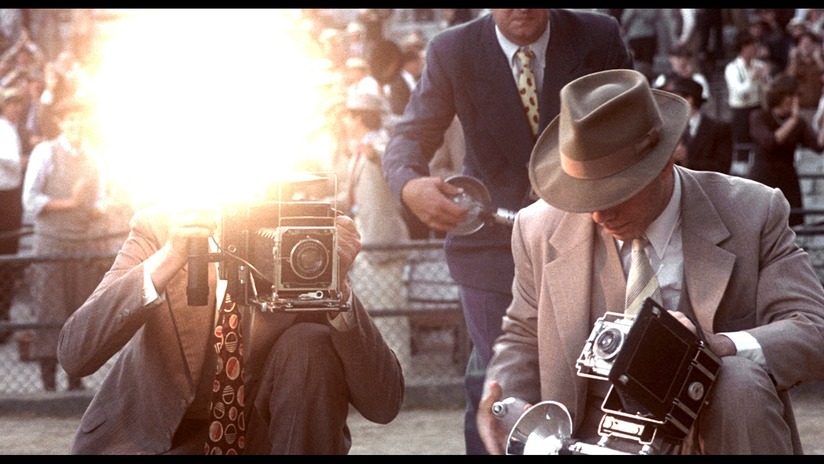
Caught a little bit of Barry Levinson's The Natural on TV the other day and was reminded of the fact that it features some of the most gorgeous cinematography I've ever seen (courtesy of Caleb Deschanel who also shot The Passion of the Christ and The Black Stallion). So, as as I did with The Age of Innocence, here's a taste of some of the film's stunning visuals.


Saturday, August 27, 2011

The Mystery of the Missing Movie (or "Body Heat" at 30)

The following is an article I wrote for the blog Edward Copeland on Film (for which I am a regular contributor) commemorating the 30th anniversary of the release of Body Heat.


There’s a kind of freedom that comes in knowing you're about to die. A lack of fear. Once you’ve finally accepted that your number is up, a strange sort of detachment comes over you. I’ve always been a pretty apathetic fellow, but I’d never experienced anything like what I felt standing in that alleyway, staring down the barrel of a .38, two fresh corpses sprawled on the grimy ground beside me, knowing full well that my next breath would be my last. I found that I didn’t give a damn about anyone or anything anymore. Not only that, but I’d lost my ability to B.S. There's no deceit in death. A man who lies to save his own skin does so because he still thinks there’s a chance he’ll live. A man who resigns himself to his fate cannot lie. So, in those last few moments of my life, as I reflected back on the twisted course of events that led me there, I knew it was the absolute truth.

It all started two days ago. It was a hot August evening in the city. I sat in my chair watching the ceiling fan spin, which did nothing to cool things off. It just blew the hot air around. The Venetian blinds in my window cast long shadows across my desk where a nearly empty bottle of bourbon sat comfortably next to an empty shot-glass. I glanced at the clock on the wall. It was almost closing time. Suddenly the door to my office opened and a tall, thin brunette dressed to the nines strolled in and closed the door behind her. “Are you Joe Cannon?” she asked.

“If I’m not, then one of us in the wrong office,” I said indicating the name on the door window that clearly read "JOSEPH CANNON: PRIVATE INVESTIGATOR." She sat down in the chair in front of my desk and crossed her legs giving me a swell view of them. "So, what can I do for you, Miss…?"

“My name isn't important. What matters is that I need your help. I would like to hire you to find…" she hesitated, took a deep breath and said, “…a movie.”

“Come again?”

“I need you to help me find a movie.” Now, in all the years I’d been a snoop, I never had a request like this. I’ve educated various women in the extracurricular activities of their husbands. I’ve helped locate missing persons. I’d even tracked down and fingered the occasional blackmailer, thief or murderer, but finding a movie? That was a new one.

“Not my line of work, doll,” I uttered. “Why don’t you try Blockbuster? There’s one down the street.”

“It closed down,” she said. I really need to get out more, I thought. “Besides, I know precisely what movie it is I’m looking for. All I need is a name. I caught it late one night on cable many years ago. I thought it was an excellent example of that genre known as film noir. It involved a man who had fallen in love with a dangerous blonde. Together they plotted to kill her husband but after the deed is done, he starts to suspect that she’s just using him for her own selfish purposes and —”

“I know that film,” I interjected. “It’s Double Indemnity.”

She shook her head. “No, that’s not it. I’m familiar with that film too and although it wouldn’t surprise me to learn that it was used as a source of inspiration given the many similarities, the film I’m looking for has some distinct differences. First of all, Double Indemnity was made in the '40s and is in black and white. My film was made in the '80s and is in color. The protagonist of Double Indemnity is an insurance salesman while the protagonist of my film is a lawyer. That one is set in Los Angeles while my film takes place in Florida in the middle of an intense heat wave. In fact, because of that I believe the title has something to do with ‘heat’ or ‘hot’… also because it’s a very sexy film. There are several love scenes that are quite erotic, though it never crosses the line into becoming pornographic. There is some nudity, but far more is implied than displayed. Whoever made it knows that the most powerful tool in making something appear sexy is the audience’s imagination.” She suddenly stopped talking, a little embarrassed that she’d just gone on for two minutes about this mysterious film. “Please, I have to find it. It means a great deal to me. I was told that if anyone could help me, you could.”

I was about to tell her that I had better things to do than help some needy broad (who wouldn't even give me her name) track down some random flick she’d had a late-night fling with years earlier, but there was something about her eyes that grabbed me: a look of desperation in them that I couldn’t shake. That’s when I made a mistake that you never make in my line of work. For the first time in a long time, I felt sorry for a client. I told her I’d help her out. Her face lit up. As I discussed my pay, she jotted down some more information on a scrap of paper (along with a number where I could reach her) which she handed to me. She rose and sauntered to the door. “Thank you, Mr. Cannon,” she said looking over her shoulder with a smile.

"Call me Joe," I said. "What do I call you?"

"I'm known to my friends as 'The Siren.'"

So, a Greek mythological creature hired me to find a movie. I guess I'd had weirder cases. I decided to start with my old Army buddy Matt Zoller Seitz. Matt was such a film freak that he had forgotten more about movies than I would ever know. The next day I called his workplace. He wasn’t there, but his office told me where I could find him. I caught up with Matt at a local park playing with his kids. He was pushing one of them in a swing when he saw me coming toward him and smiled. “Joe,” he said holding out his hand as I approached him. “It’s been a while. What’s new? You still in the gumshoe business?"

I shook his hand. “Still. In fact, I’m on a case right now. I’m looking for a movie.”

“Well, I’m your man. What do you got?”

“It’s film noir. Story involves some sap who gets mixed up with the wrong dame. Together they kill her husband and then things start to go bad for him.”

“Sounds like Double Indemnity. Released in 1944. Directed by Billy Wilder.”

“Nah, this one’s more recent,” I said pulling out my notepad and looking at the details The Siren gave me. I told Matt that this film was made in the '80s. I mentioned it featured William Hurt as the sap, Kathleen Turner (in her first movie role) as the voluptuous vixen he falls for, the late great Richard Crenna played her husband, J.A. Preston was the investigating cop, Ted Danson (in what apparently was one of his best performances) portrayed a sleazy rival lawyer who is always dancing wherever he goes and a very young Mickey Rourke was an explosives expert. I went on about what the lady had told me regarding the film’s visual style: how the camera could glide with confidence and grace but also know precisely when to let it rest in a static shot. As I read more and more details off, I noticed Matt’s smile slowly fade away. It was replaced by a look of concern. He was clearly getting uncomfortable. “I…uh, I don’t know that one. Sorry. It just doesn’t ring a bell.”

“You not knowin’ a flick? That doesn’t sound like you, Matt.”

“Well, I guess you can’t know ‘em all, huh?” he said wiping the sweat off his forehead with a handkerchief. “Now, if you’ll excuse me, I gotta take the kids home.”

“What’s wrong, Matt?”

“Nothing. Just…let this one go, Joe. Let it go.”

Matt’s warning echoed in my head as I drove all over town talking to other friends of mine who happened to know a lot about movies. Everywhere I went I got the same answer. They didn’t know. Of course, I knew they were lying. They did know and they weren’t talking. They were scared. Someone had put the fear of God into them, but who? And why? As the evening rolled in, I was no closer to finding this flick than I was to finding Nick Jonas’ talent. I decided to try the local library. Not only did they have a very extensive collection of movies to check out, but I happened to know a girl who worked there. Her name was Sheila O’Malley. She was a blonde, bookish type with whom I’d had a thing going a while ago, but she wanted more so I got out while the getting was good. Since then she’d had a string of casual boyfriends, but I still think she was waiting for me to come to my senses again and I was able to use that sometimes to my advantage. I caught up with her as she was getting ready to lock up. “Well, look at what the cat dragged in.” she said smiling wryly. “What brings you here, Joe?” I told her everything I knew about the movie and she agreed to help me out, for old time’s sake. She typed the information into her computer database. “Ah, yes. Here we go. The film you’re looking for is called Body Heat. It was released on August 28, 1981 and was written and directed by Lawrence Kasdan. He’s the guy who wrote the screenplays to Raiders of the Lost Ark and The Empire Strikes Back. He later went on to direct The Big Chill, Silverado and Mumford, but Body Heat was his first film.”

“Yeah, fascinating," I said suppressing a yawn. "Do you have it?”

“As a matter of fact, we do.” She led me to the area where they kept their movies. As she looked through the numerous rows of plastic cases for it, I decided to ask her if she had ever seen the film herself and if so what she thought of it. “Oh, sure. I saw it a long time ago. I quite liked it. I remember thinking that the music in particular was very good. John Barry, the fella responsible for such great scores as Midnight Cowboy, Somewhere in Time and many of the James Bond films, wrote a very lush, sensual jazz score. It captured the steamy essence of the story quite effectively I thought. In fact, it’s one of his best scores.” She stopped and looked off nostalgically. "I can still hear that sultry sax solo playing over those opening credits." I cleared my throat, she snapped out of it, pulled out a case with an image of a mustached guy and a hot blonde dressed in white on the cover. “Here we go.” She opened it and her brow suddenly furled. “Well, that’s strange. It’s not in here.”

“What?” I asked.

“It should be here, but it’s not. There’s no movie in the case. Someone stole it.”

This just gets more and more bizarre
, I thought. “Something’s going on here, Sheila. I don’t know what it is, but it doesn’t feel right. Can you tell me who the last person was to check it out?”

“Sure.” She led me back to her computer where she looked up the film’s rental history. “Someone named Ross Ruediger.” I thanked her and headed for the door. “What are you getting’ yourself into here, Joe?” she called out to me. I pretended not to hear.

So, I had a title and I had a name. I decided to pay a visit to this Ruediger fellow and see what he knew. I found his address in the phone book and the following morning showed up at his home. It was a nice suburban house with a perfectly mowed lawn and a white picket fence. As I approached the front door, I noticed that it was slightly open. I drew my piece and cautiously entered. The living room had been ransacked. Someone was looking for something. Chairs were overturned, couch pillows were cut to bits and dozens of opened movie cases were spread out all over the floor. It was quite the collection: L.A. Confidential, Brick, Devil in a Blue Dress, The Long Goodbye and many more. What was most striking about this residence, however, was the dead body lying face-up in the middle of the floor. He looked like he had been shot in the chest. I leaned over, pulled out his wallet and checked his I.D. It was Ross. There was very little else in the wallet aside from a couple bucks, a library card and a scrap of paper with some random letters and numbers that looked like they'd been scrawled hurriedly on it: "D.B. 5552314 82881." I pocketed the cash and the paper, rose to my feet and made my way to the kitchen. Unlike the living room it was immaculate. The floor had been swept, the counters were clean and there were healthy potted plants everywhere throughout it. Suddenly something hit me over the head. I fell forward and everything went black.

When I woke up, my ears were ringing like the national anthem and my head felt like it had gone 12 rounds with Tyson. How long had I been out? I opened my eyes and found myself staring up into the faces of two of my least favorite people in the world: Lt. Dennis Cozzalio and Sgt. Jim Emerson of the police department.

“Hey, sleeping beauty. Welcome back to the land of the living,” Cozzalio said. Together, the two of them picked me up and threw me into a chair next to a small table in the middle of the kitchen. They told me that when they received a call from some neighbor who heard a gunshot in this house, they never expected to find me here. They then proceeded to ask me a series of questions in rapid succession, each one taking a turn. It was like watching a tennis match — and I was the ball. I told them everything I knew but decided it was wise to leave out a few little things, such as the truth. Cozzalio wasn’t buying my yarn.

“That’s some story,” he said rolling his eyes. “If I ever enter a fiction-writing contest I’ll have to remember it.”

“Now, why would I lie?”

“To protect your client maybe. Tall, thin brunette. Goes by the nickname 'The Siren?'” I froze. How did he know about her? Cozzalio pulled out my notepad. "It was found on the floor next to you. What's this Siren want with you? And what does it have to do with all these details about some neo-noir movie?"

"You know I can't tell you about what goes on between me and a client, Lieutenant."

"Well, you're not going to be doing her any good by keeping quiet. We just got a call that her body was found in her apartment across town. Looks like she was plugged with a .38.”

“Same weapon it seems was used on Mr. Ruediger here,” Emerson added.

"So, you see, Cannon," Cozzalio continued. "This is a double homicide. Somehow you’re connected to both of them and you damn sure know more than you’re tellin’ me. So, give…or am I gonna have to haul you in on suspicion of murder.”

He was bluffing. “Oh, come on, Lieutenant. You think I came in here, popped this guy and then decided to take a nap until you boys showed up?”

“Then give us something, Cannon.” Emerson barked. “What can you tell us about this Ross Ruediger?”

“He liked neo-noir?” I joked. Cozzalio wasn't amused. Emerson looked confused.

“What’s neo-noir?” he asked.

Cozzalio turned to him. “Neo-noir is a term used to describe a recent sub-genre of movies that attempt to replicate many of the same elements seen in classic examples of film noir from the '30s, '40s and the '50s. Some have said that noir was a genre distinctive to a particular historical era of cinema. Others have said that the genre is more defined by its content (style, themes, etc). Neo-noir tries to imitate the form, if not perhaps the function, of traditional noir and sometimes it’s highly successful, as it was in Chinatown. Other times, such as The Black Dahlia…well, not so much.”

“Can I go now?” I asked. Cozzalio glared at me. He knew he had nothing he could hold me on.

“Don’t leave town,” he snarled.

So, The Siren was dead. Probably shot by the same gun that killed Ruediger. What was going on? What was so important about this movie? I walked the streets trying to figure it all out, but my head hurt. I stopped at a drugstore a block from my office and bought an ice pack. My head was still throbbing as I trudged up to the stairs to my office. Before I could get my key in the lock, the door flew open and a hand pulled me in and threw me to the floor. “Good evening, Mr. Cannon,” a polite but sinister voice said. I looked up and saw a small, extremely well-groomed man in a suit that cost more than a year’s worth of my rent sitting in my chair with his feet up on my desk. I wasn’t sure how, but there was something familiar about him. “I hope you don’t mind that we let ourselves in.”

“Not at all,” I muttered as I slowly stood up. “Make yourself at home.”

“Thank you. Allow me to introduce myself. My name is David Bordwell and this is my associate Odie.” I turned around and got a good look at the goon who pulled me in. He was easily twice my size with hands as big as cocoanuts. He grunted a greeting. The little guy in the fancy suit pulled a tiny clipper out of his pocket and started to trim his nails as he spoke to me. “Word is that you’re looking for a movie that goes by the name of Body Heat? Is that true?”

“What’s it to you?” The mountain slapped me upside the back of the head and my knees became acquainted with the floorboards once again.

“Let’s just say that I am also interested in obtaining that particular motion picture. I’m not sure if you’re aware of this, but it is very hard to find these days. All existing copies seem to have vanished. If one is indeed located, it could be very valuable. I was wondering if I could retain your services in finding it for me?”

“Thanks, but I’m not interested.” Again, his henchman smacked me to the floor. That’s it, I thought. I’m tired of being knocked around on this case. As I slowly rose to my feet I shot him a dirty look. “Touch me again and you’ll regret it,” I threatened.

“Easy, Odie.” the suit remarked. “I don’t think you realize how important a person I am. I could reward you very handsomely for it.”

“I don’t know who you are and I don’t care.” I said. Odie took another swing at me, but this time I ducked and brought my knee up into his groin. He went down like the walls of Jericho. “I warned you.” I gloated as he rolled around on the floor whimpering. The suit rose from my chair and walked around the desk toward me.

“It’s so hard to find good help these days.” He reached into his jacket, pulled out a small pad and a pencil and started writing something on it. “If you are ever interested in becoming a rich man, ring this number here. It's my private line.” He ripped the slip of paper from the pad and held it out to me. Reluctantly I took it. With a bow, he was gone, taking his limping sidekick with him.

I sat down at the desk and removed my hat. Who was this guy and why did he seem so familiar to me? I glanced down at the paper and was about to crumple it up when I noticed something. The phone number he wrote was "555-2314." I pulled out the paper I got off Ruediger's body. "5552314." It was the same number. That's when I noticed the letters. "D.B." David Bordwell! Ruediger knew Bordwell! Not only that, he had his private number. The only thing that I had left to decipher on the sheet was the remaining number: "82881." That's when it hit me. I grabbed my phone and called the library hoping Sheila would still be there. She was. I asked her when she had said the release date was for Body Heat. "August 28, 1981," she immediately responded. 82881. It was a date! 8-28-81! Thirty years ago today! In a flash, it all suddenly made sense. I remembered where I'd seen Bordwell before and I knew where to find the flick.

"Sheila, I need you to do something for me," I said. "I need you to call the police department. Ask for a Lieutenant Cozzalio or Sergeant Emerson. Tell them to meet me in 30 minutes at this address."

"What's going on, Joe?" Sheila asked.

"Just do it, Sheila," I asserted. "I know who murdered Ruediger and The Siren. I also know where to find the missing movie." I gave her the address to tell the police and she agreed to call them right away. I hung up and immediately dialed Bordwell's private number to set up a meeting. First, however, I had to make a quick stop somewhere else.

A half-hour later I was standing in the middle of an alley between Cain Street and Chandler Boulevard. My hat's brim dipped low, my trench coat's collar rose high. It wasn't that I was cold. This was just the kind of neighborhood in which you didn't want to draw attention to yourself; the kind of place where the sound of gunshots were so common that neighbors weren't reporting them to the police. I looked around nervously as I waited. Suddenly, I heard a voice behind me.

"Well, that didn't take long, Mister Cannon," I turned around and standing before me was the little guy and the big guy. "Is that it there?" he said pointing to the disc I held in my hand. I nodded. "Where did you find it?"

"At Ruediger's house. When you tossed the place you forgot to look in the potted plants in his kitchen…one in particular. When a man takes great care to mow his lawn and see that his plants are watered and healthy, it should stand out to you when one plant is dying. It means he's got something else hidden in there." Bordwell looked impressed as he held out his hand. "Before I hand it over, I was wondering if you could tell me what would someone with unlimited access to the Warner Bros. movie archives want with a copy of Body Heat?" He smiled and asked me when I realized who he was. "I knew your face when we spoke in my office earlier, but I just couldn't place it. Then I remembered reading an article in Variety a few months ago about how you had taken over the DVD/Blu-Ray division at Warner Bros. studios. I just couldn't figure out why someone in your position would so badly want to get their hand on a copy of this or any other Warner Bros. title."

"Have you ever seen it, Mister Cannon?" he asked. I shook my head. "Well, it's a fine film. A damn fine film. It was well-received by critics back when it was released and the years have been very kind to it. It's one of the treasures of our library and were it to be re-released on DVD and Blu-ray in a special 30th anniversary collector's edition it could make us a fortune…but only if people didn't already own it. The economy has hit everyone hard, Mister Cannon. Consumers don't double-dip anymore. They're tired of having to repeatedly purchase their favorite films in new formats. Just as Ridley Scott's FINAL CUT of Blade Runner promised closure to so many cinephiles, so would this definitive release of Body Heat be the last chapter in the life of a significant piece of cinematic history."

"That's why it's so hard to find nowadays," I continued. "You've been snatching up every available copy out there so that demand would be high for your release of Body Heat with all its 'bells and whistles.' You also bribed or intimidated reputable cinephiles, such as my buddy Matt Zoller Seitz, so they'd keep their mouths shut. Tell me, why did you kill Ross Ruediger? Was he refusing to give up his copy of it? Did he love neo-noir movies so much that he couldn't bear to part with it? Or was he just threatening to spill the beans on the whole operation? And what about The Siren? She was just a woman in love. What did she ever do to deserve what she got?"

"You know, I'm bored with this conversation," he said casually pulling out a .22 and pointing it right at me. "Now, if you don't mind, Mister Cannon, kindly hand over the disc." I tossed it to him. "Thank you."

"Are you going to kill me too? Just as you killed Ross Ruediger and The Siren?"

Bordwell chuckled. "This may be hard for you to believe, Mister Cannon, but I've never heard of this…'Siren.' I didn't kill Mister Ruediger either. In fact, he and I had an understanding. He was very keen on selling me his copy of Body Heat. That's why I gave him my private number. He was supposed to get in touch with me by today, but he never called. However, it's no matter now. Goodbye, Mister Cannon." Bordwell bowed and turned to leave. Odie grunted his usual response and turned with him. Was he telling the truth? Did I have it all wrong? If he didn't kill them, then who did? At that moment two gunshots rang out and both Bordwell and his henchman fell to the ground. The shots came from behind me. I whipped around and standing there holding a smoking .38 was the last person I ever expected to see.

"Sheila?"

"That's right, Joe," she said smiling at me.

"What the…? I don't get — How? Why?"

"It's a long story, Joe, but it goes back several years…to the day that you dumped me. I was heartbroken, devastated. I invited my best friend over to comfort me. I believe you two have met. She called herself 'The Siren.' Anyway, we ended up watching a movie on late night television together. It was Body Heat. I didn't quite know what to think of it that first time. I enjoyed it but was not blown away. Over the years, as I went through relationship after relationship with other men, I couldn't get certain images and lines of dialogue from that film out of my mind. Kathleen Turner in that gorgeous white outfit standing alone on the pier staring off at the ocean, William Hurt admiring his new fedora in the reflection of the car window, the haunting sound of those beautiful wind chimes…All these moments stuck with me. That's when I decided, a few months ago, I needed to watch it again. By this time I had the job at the library and checked out our copy of it. It was then that the film's greatness became apparent to me. I fell in love with it. Its style, its elegance, its romanticism. It is an impeccably-made motion picture. I realized that I didn't need a man as long as I had Body Heat. But Bordwell and his greedy friends at Warner Bros. were making sure that nobody could get their hands on it. I knew it was only a matter of time before they tried to take the library's copy away too. I had to make sure that didn't happen. So, I chose a sap whom I could seduce into checking it out permanently."

"Ross Ruediger," I said.

"It was a cinch picking him. I saw him in the library all the time. He loved neo-noir and when I came on strong to him one day, he folded like a pup tent. Men are so easy to manipulate. In a few weeks, he would do anything for me…even hold on to my movie for me, hiding it so that nobody could find it."

"And you were able to make sure that it was constantly checked out, so that nobody could ever take your precious Body Heat away from you. Clever." Sheila wore a somewhat triumphant expression. "So, why'd you kill him?"

"Because he was weak. The day after you came by the library, I went over to his house bright and early hoping to get him to give me the movie before you showed up and strong-armed him into handing it over to you. The man loved good movies, but he had no backbone. Bordwell had already gotten to him, as Ross tearfully confessed to me that morning, and talked him into selling it back to the studio. He could no longer be trusted. He had to go."

"So you shot him and then ransacked the place looking for the movie. Is that when I showed up and you ambushed me?"

"You guessed it. I have to admit that I was a little surprised to see you turn up at the library looking for it, Joe. I couldn't figure out why you were suddenly interested in the film, so while you were out cold I went through your pockets, found your notepad and saw the name and phone number of your new client: my old friend, The Siren. I guess the same thing had happened to her. She also had fallen in love with that film that we were both introduced to that night. She must also have became obsessed with having it. Well, I couldn't let her. This movie was mine and mine alone. Nobody was going to take it away from me. Ever." She raised the gun. "I guess I owe you some thanks, Joe. Not only did you locate the movie for me, but if you hadn't broken up with me all those years ago, I never would've even found out about it. Now, get the disc."

"You'll never get away with this, Sheila. The police will be here any —" I stopped when I realized that I had asked her to call the police. She smiled at me. I sighed, walked over to the Bordwell's small body which lay on the ground behind me, took the disc out of his hand and turned back to face Sheila. "Throw it to me."

"Don't do this, Sheila," I pleaded with her. "No movie is worth this."

"You don't know that. You haven't seen it."

"And I guess I never will." I crunched the disc in my hand before dropping it to the ground and stepping on it. Sheila let out a noise like nothing I'd ever heard. It was more than a scream. It was the sound of a person's soul being crushed. She looked at me with tears streaming down her face and a look of intense fury in her eyes.

"You bastard!" she said cocking the gun.

This is it, I thought. This is how you die. I closed my eyes and waited for the gunshot that I knew was going to end my life. There was a loud boom. I actually heard the sound of my own death. So, where did she hit me? I couldn't tell. I felt nothing. Did she miss? I opened my eyes just in time to see Sheila fall forward. At that moment, Sgt. Emerson emerged from around the corner holding his gun. He asked me if I was OK. I told him I was fine. Just in shock. "Cozzalio's been having me follow you around ever since you left Ruediger's place this morning. Good thing too."

"Where were you when she killed the other two?" I asked.

"I was…um, indisposed at the moment," he said looking a little embarrassed. "I ran over as soon as I heard the gunshots and that's when I saw her pointing that .38 at you. Don't worry. I heard her whole confession. You're off the hook, Cannon." Within 10 minutes, there were a dozen cops at the scene, the alley was quartered off and Lt. Cozzalio was taking my statement. This time, I decided to tell him everything, leaving nothing out.

"Well, it's only a shame you had to destroy the movie too, Joe. We could've used that."

"I didn't destroy it." I said pulling another disc out of my pocket. "While I was picking up Body Heat at Ruediger's place I grabbed another disc just in case. I don't even know which one it was. Sin City I think." I handed it to him.

"All this trouble over a movie," he said holding it up and looking at it. "I hope it was all worth it." I asked him what would happen to it. "Oh, it's evidence now," he answered. "It'll get put away with all the other junk for a long, long time. Why? Were you interested in watching it?"

"No, thanks," I replied lighting a cigarette. "Too many people have died for that thing." Cozzalio was still examining it as I turned to exit the alley. I stopped, however, and glanced back over my shoulder one last time before walking off into the night. "But I hear it's damn good."


A special word of thanks to all of my film-blogging friends who allowed me to use their names in this crazy, but amusing, little endeavor of mine:
Matt Zoller Seitz
The Self-Styled Siren
David Bordwell
Jim Emerson
Ross Ruediger
Odie Henderson
Sheila O'Malley
Dennis Cozzalio

Black-and-white image courtesy of Jim Ferreira Photography.