Monday, May 18, 2015

Stick Figure Cinema 2

Here's another batch of "Stick Figure Cinema" videos.


Ferris Bueller's Day Off


There Will Be Blood


The Birds


More to come.

Friday, May 15, 2015

Morose Max and the Fiery Road Picture


Who would have thought?

Who would have thought that a 70-year-old Australian filmmaker with merely a dozen features to his name (and whose only work over the past two decades has been family-oriented fare) reviving a 30-year-old franchise with a new actor in the lead role (whereas the original actor was made an international superstar by said series) telling the most minimal of stories and using primarily practical effects (mostly just augmented by CGI rather than leaning on it) and a lot of impressive physical stunts, would be the one to swoop in here in the year 2015 and take the Hollywood summer movie season by storm?

Well, it happened.

George Miller's Mad Max Fury Road is a refreshing return to a style of filmmaking we hardly see anymore. It doesn't really show us anything new. It shows us something old and that, in itself, is new. It is a grand, glorious, in-your-face action extravaganza that is breathtakingly thrilling and visually spectacular. It has charmed the critics (earning an almost unprecedented 99% on rottentomatoes) and is sure to make tons of money. It is going to be the movie to beat this summer.

Tom Hardy steps into the role of Max Rockatansky, the former police officer from a post-apocalyptic world where the main treasures are oil and water, who, following the death of his wife and child (glimpsed here only in the briefest of hallucinatory flashbacks), has become an amoral wanderer in a desolate wasteland, living only for survival and trying desperately to outrun his past. The story of this latest entry is pretty simple. Indeed, it is not only virtually identical to the previous two films but to just about every lone stranger/gunslinger western you've ever seen (Max is like a futuristic incarnation of Eastwood's mysterious "man with no name"; he rides in, helps a group of people with a problem and rides out). This time he reluctantly aids a small group of women led by the warrior Furiosa (the splendid Charlize Theron) who are trying to escape their despotic "husband" that uses them to breed heirs to his "kingdom." That's it. It is the thinnest of premises upon which Miller builds what is essentially a two-hour chase film (Miller himself has called it that) and yet somehow the distilled-down-to-its-bare-essence plot makes for an even more powerful cinematic experience. There is no complexity here. There is no depth. There are no gray areas. There is very little dialogue (especially from the lead). What there is are good guys and bad guys locking horns (sometimes literally) in the middle of the desert at 90 mph. It is an intense visceral experience uncompromising in its power and passion. It is pure cinema made by a director who, despite his age, seems to be at the top of his form. It is an unapologetic summer blockbuster and as such should be seen where it deserves to be seen: on the big screen.

I really only have one minor quibble with it and that is in the casting of the lead. I have liked Tom Hardy in just about everything I've seen him in so far, but here he is somewhat... dull. One could argue that the character of Max doesn't necessarily give an actor much to work with, but I can't help but feel that someone else might have been able to do a little more with it. Hardy is physically capable and not underwhelming to the point that he detracts from the rest of the film, but at times when he is supposed to be brooding he looks kind of tired and on those rare occasions when he does speak, he just sounds a bit flat. In a film that is so relentlessly energetic, it is strange to have at its center an individual who is relatively lifeless. I've never thought that Mel Gibson was an especially great actor, but when one looks back at what he did with the same character, one sees there is perhaps more subtlety and nuance in his performance than he has been given credit for. Gibson's Max always seemed angry, like he was on the verge of unleashing that inner "madness" at any moment. There was a real rage behind his eyes (due, at least in part perhaps, to the inner demons the actor himself was battling) and this made his silent stoicism all the more electrifying and his acting out, when he did finally release all that pent up aggression in those stunning and violent action scenes, all the more palpable. Mel's Max was truly mad. Hardy's Max seems more... morose.

However, Fury Road is so excellent that, to a degree it doesn't really matter who plays Max. It could have been Gerard Butler for all the difference it would have made (and indeed in some shots it almost looks like Butler). The reason to see the movie is not for the psychological/emotional depth of the protagonist or the sheer charisma (or lack thereof) of its lead actor. It is for the raw, kinetic filmmaking that Miller has brought back to an industry that was sadly needing it. Highly recommended.


Thursday, April 30, 2015

Moses Supposes


There's a brief moment I love in the Dreamworks animated film The Prince of Egypt where Moses encounters the burning bush and is told to remove his sandals because he stands on holy ground. As Moses glances downward he notices a collection of tiny pebbles between his feet rolling away from the bush on their own. That image reminds me of the statement Jesus makes upon entering Jerusalem where he responds to the Pharisees entreaty to silence the singing crowd by saying, "If they were to be quiet, the stones would cry out." I've always kind of felt like that is what the little rocks beneath Moses are doing at that moment. They, through the action of their removing themselves from the holy ground, are declaring their creator, Yahweh, as their authority. Ironically, they, as mere rocks, are naturally showing more deference to the God of the universe than a living, breathing, thinking human being is doing. It's a wonderfully ironic and poignant image and it takes up about two seconds of screen time.

I mention that scene only because after (finally) viewing Ridley Scott's Exodus: Gods and Kings earlier today, I couldn't help but notice that there were no scenes that inspired a similar sense of wonder or reflection. There were no moments that illuminated anything new for me about this age-old story. There were no insights into the character of Moses, Pharoah or God that made it an especially compelling experience. I felt like I was simply watching a darker, grittier and -- because of all the CGI -- more expensive telling of the tale. The performances are fine I guess (Sigourney Weaver is utterly wasted with, I swear, like two lines in the entire film) but the characters are pretty bland. Scott, as usual, does the spectacle well (the most impressive sequence being, as it tends to be in these movies, the climactic Red Sea crossing), but at 2 1/2 hours, the film, which is about an hour longer than the animated feature and about an hour shorter than the De Mille classic The Ten Commandments, felt longer than both combined, focusing a lot of attention on mundane details that, frankly, seem unimportant (the freed Isrealites traveling through the desert with Pharaoh in pursuit takes up about ten minutes of screen time and devotes a lot of attention to the minutiae of their being tracked, misleading the army, etc) but glosses over other things that could've been more fleshed out (Moses meets Tzipporah for the first time and then a scene later is marrying her; Prince of Egypt, at least, showed their courtship in a song/montage).

Just to be clear, I am not one of those Christians who expects cinematic adaptations of biblical stories to be obsessively faithful to the text. I might disagree with them, but I am not angered by the suggestion that Moses might have been insane and that his conversations with God were delusions (indeed, other films before this one have hinted at such a possibility, but in a more subtle and ambiguous way), I don't take issue with depicting God as a petulant, British boy with -- as my dad said -- a bad haircut, or I am not offended by the implication that a number of the miraculous events that occurred could have actually resulted from natural phenomena (I actually don't have a problem with that, although I noticed that the film conveniently sidesteps Moses turning his staff into a serpent). I recognize that these are works of art and, as such, are expressions of the filmmakers' own ideas and worldviews. The Pietà says more about Michelangelo than it does about Mary or Jesus.

I just expect that they be interesting and/or provide me with something substantial to think about regarding the account in question. Ten Commandments did that. Prince of Egypt did that. Heck, even Darren Aranofsky's Noah did that. Alas, Exodus, though it is stunning to look at, does not. It commits the ultimate movie sin not of being blasphemous, but of being dull.

Tuesday, February 10, 2015

"Wick-ed" Action


Take Unforgiven, Road to Perdition and The Professional, roll them all together, remove any depth and/or substance, add a rock soundtrack, a bluish/greenish tint to everything and, last but not least, stick Keanu Reeves and a cute little canine in the middle of it all and you end up with John Wick, a flashy, slickly produced and at times surprisingly funny action flick that doesn't have one single original idea in his head and yet still manages to be highly entertaining nonetheless. Reeves plays the titular character, a former hit man grieving over the recent death of his wife (for whom he retired) whose newly acquired puppy, a final gift from his beloved, is killed by some burglars who break into his house one night to steal his car. The rest of the movie is him seeking revenge on these lowlifes, one of whom is the son a prominent Russian mobster.

That's it. That's the whole plot.

I liked John Wick and partly because of its very simplicity. It is, in a way, a very honest and straightforward action picture. It understands that whatever plot or narrative it does have is really just an excuse to stage some kick ass action scenes. There's no elaborate conspiracy, no drug deal gone wrong, no corrupt socio-political system that the protagonist has to break up, etc. An ex-assassin's dog is killed and he wants to take down the guys that did it. That's all. Naturally in the process he has to dispatch every anonymous bad guy that gets in his way (seriously, he must kill at least 50 people over the course of this movie) in some exciting and extremely well choreographed -- not to mention comprehensibly shot and cut -- action sequences. It's refreshing to see a movie where the camera remains on the action for a while such that you can actually see what is happening and to whom (not as long as Soderbergh's Haywire, but still, relatively speaking, a long time) as opposed to most action movies nowadays which are shot with shaky cam and cut to within an inch of their life. Reeves, who still has his limitations as an actor, is really quite impressive (what is he now, 50?) as he appears to do a lot of his own stuntwork and is really rather agile in a very physically demanding role.

Yes, all of the action movie tropes and cliches are here (a fun drinking game would be to take a sip every time you see a helicopter shot of the city at night; even if you made it to the end of the movie, the final credits would do you in) and there isn't much to linger long in the memory after seeing it, but so what? It's still a fun ride.

Wednesday, February 4, 2015

Stick Figure Cinema

Despite not having written anything for my blog in a long time (sorry about that), 2015 is still shaping up to be a pretty exciting year for me cinema-wise. I have just started a new venture wherein I produce short YouTube videos (done entirely on the animation app on my phone) that recreate scenes from great movies using only stick figures. I call it "Stick Figure Cinema" (SFC) and I have already completed three entries.

SE7EN


Fargo


Raiders of the Lost Ark


Stay tuned. More to come.

Saturday, August 23, 2014

The Greatest Film I've Ever Seen


The following is a post I wrote several years ago when I was a regular contributor to Edward's Copeland's Tangents. I am re-posting it here for the Spielberg Blog-a-thon (hosted by Kellee of Outspoken & Freckled and Michael of It Rains, You Get Wet) because I still stand by it.


The phrase "I know it when I see it," uttered by Supreme Court Justice Potter Stewart regarding pornography, is an expression that, at one time or another, we've probably all heard used to encapsulate the frustration of failing to define something whose basic nature seems otherwise unexplainable. I mention it only because I've been wondering lately if art isn't also like that. It is nigh impossible to define and/or analyze a great work of art to such a degree that the elements that make it timeless and brilliant can be adequately determined, nor a basic "formula" be found. It's like the color yellow. You can't really define it. You have to just point at it and say, "See that? That's it." When I think of some of the works of art that I consider to be among the greatest ever created — Shakespeare's Hamlet, Mozart's "Requiem," Vermeer's "Girl With a Pearl Earring" — I find myself struggling to find the proper words to capture their greatness. In the end, I can't really articulate what makes them great. I have to just point it out to others and see who "gets it" and who doesn't. Well, this piece that I am writing for the "Spielberg Blog-a-thon" is about a film that I think falls into that category.

To be clear, I realize how absurd it is for any individual to declare a particular film the "greatest ever made," because there's just no way that anybody can possibly know that (unless maybe they've seen every film ever made...which, of course, nobody has). However, I do think that a person can make a definitive statement about the greatest film that he/she has ever seen (based on whatever criteria he/she wishes to use). Nevertheless, you would be hard-pressed to find a cinephile who's willing to commit to such a monumental claim (the most you might get out of them is their personal "favorite" film, but even that is rare). Why is this? Well, my theory is twofold: first off, they know that their pick could change with the very next film they watch and secondly, they are well-aware of the fact that it's really just a subjective opinion which says more about them than it does about the film itself. I myself possessed this reluctance for the longest time. Whenever I was asked what my favorite film was (or, even more rarely, what was the best film I'd ever seen), I hemmed and hawed for a while, throwing out several disclaimers and mentioning a list of about eight or nine films that could qualify for that honor.

Over the years, though, I have found myself returning to one film over and over again: the film that had a profound impact on its director, on the culture at large and on me personally (as a cinephile certainly but also as a human being). It was the film I held up as the standard by which to measure all other films. It was the film I thought of whenever anyone spoke of "cinematic high art" or how the motion picture medium could achieve its true potential. I would discover new and profound truths contained within its frames every time I watched it. Far from diminishing in quality with each viewing, it actually improved in my eyes. I finally had to admit the truth to myself. This is the greatest film I've ever seen and probably ever will see.

It's Steven Spielberg's masterpiece Schindler's List.

I first heard of Spielberg's "Holocaust flick" in the summer of 1993 when I was reading an issue of Entertainment Weekly. I was flipping through their "Winter Movie Preview" section when I turned the page and saw the photograph seen below of Liam Neeson as Oskar Schindler addressing "his" Jews staring back at me. I knew who Spielberg was because I had grown up with E.T. and the Indiana Jones adventures and had only recently become interested in him again because of the movies Hook and Jurassic Park. Like a lot of people at the time, my reaction was one of confusion and skepticism. This did not seem like the kind of film that Spielberg was typically known for. Could he pull it off or would it be a failure on a massive scale? I was curious to say the least.


When the film was eventually released during the winter of my senior year in high school, I went with my dad to the movie theater on Ninth Street in Corvallis, Ore. to see it. I wasn't entirely sure what to expect. I knew the film was going to be serious. I knew it was going to be heavy and, not least of all, I knew it was going to be very violent, but I also had a sense that it was going to be worth seeing. I didn't realize it at the time, but I was at a crucial point in my development as a cinephile. I had always loved movies, but I approached them primarily as a form of entertainment. The idea that they could also function as a means of artistic expression was a concept I was only beginning to become vaguely familiar with (prompted especially by a film history class, led by my good friend Tucker Teague, which I had recently attended). Needless to say, I was also moving rapidly toward a major crossroad in everyone's life. I was 17 years old. Graduation was just around the corner and I was preparing to leave home and head off to college to try and figure out who I was and make something of myself. All this served as the context for my introduction to the film and may even help to partially explain why the film had such a big impact on me.

When the lights went down and the movie started, I was actually bewildered at first because I had understood that the entire film was in black-and-white. What I was seeing was in color. A hand was striking a match and lighting some candles. A Jewish family was gathered around a table in a small room celebrating the Sabbath. The patriarch was singing something in a language I didn't understand. Was this a mistake? Were my dad and I in the wrong movie? Soon the family faded from the scene (though the song/prayer could still be heard) but the candles were left behind. As one shot dissolved into the next, clearly signifying the passing of time, the candles burned further and further down (this also was when the main title appeared on the screen indicating to me that this was indeed Schindler's List, though I was still somewhat confused). Finally, the camera showed only a solitary candle with the flame about to burn itself out. I didn't notice it then but the candle and the background were already in black and white. Only the tiny flicker of flame was still in color. The flame soon extinguished and the resulting thin streak of smoke that flowed upward from it was followed by the camera. A train whistle was suddenly heard and the movie cut to a cloud of thick, gray smoke that poured forth from the smokestack of a locomotive. Now the film was completely in black-and-white and I knew I was in the right movie.

The greatest films have openings that are unforgettable. The Godfather has that wonderfully slow zoom-out with the heartbroken father seated in a dark room relaying his tale of woe to a mysterious figure ("I believe in America."). Citizen Kane has the magnificent montage of shots of that fortress Xanadu which culminates in a single whispered word ("Rosebud.") and a shattered snow globe. Schindler's List has the sequence I just described. There is so much going on just in that brief collection of sounds and images (Spielberg's symbolic use of color and its lack thereof, the imagery of the candles being snuffed out and the ensuing smoke, etc) that I could write the rest of my piece on it alone. Suffice it to say that from that opening, I already was engaged by the film. Indeed, I was captivated and that sensation never let up for the next three hours and 14 minutes (during which I wept a couple times). When it was completely over and the lights came up I noticed that most of the people who were in the theater with us also were still sitting there, dumbfounded. We all looked like we'd been sucker-punched. Slowly and silently, everyone started to get up and walk out including my father and I. As we often do, we talked about the movie in the car, though I don't remember much of what we discussed. What I do remember is his taking me by Fred Meyer on the way home and purchasing the film's soundtrack for me because among the many things that stood out to both of us was John Williams' sad, but achingly beautiful, musical score.


Like a lot of folks, my initial reaction to the film was one of shock. I was horrified by what I had seen on screen. I was shaken to the core of my being and consequently couldn't revisit the film for a long time afterward. I just knew that I loved it. It reached me in a way that very few films can or do. I also remember thinking that this was a different kind of movie than most of the other films I had seen...not just in terms of content but in terms of style. My clumsy way of characterizing it back then was to say that it felt "like a foreign film only it was in English; it didn't feel like a Hollywood movie at all." I was also astounded that it had been directed by the same man who was responsible for the movie I had seen only six months earlier that featured giant dinosaurs eating people. "This is not the same man. This can't be the same man," I thought to myself. Nowadays when I watch the film (having in the interim become far more familiar with the subtleties and nuances of Spielberg's general technique), naturally I can see his hand in the execution of this story, but in a sense I was right in my initial reaction. Schindler's List was not helmed by the same Spielberg who did Jaws, E.T. or even his previous serious efforts such as The Color Purple and Empire of the Sun. Schindler represented a major challenge for Spielberg. In bringing this story to the screen, he pushed himself in a way that very few filmmakers ever do. He did so not only technically but emotionally and spiritually as well. He re-connected with something in himself that he had denied for a very long time: his own Judaism. Making Schindler's List changed Steven Spielberg just as watching it changed me.

Although controversy has always surrounded Schindler's List, I myself wasn't aware of most of it upon its release. All I heard was praise for the film. This was probably just as well since my passionate love for the film would've blinded me to anything negative anyone would've said about it. As the years have gone on, and I've watched it numerous more times as well as familiarized myself with the various writings on it, I feel I am in a better position to understand and appreciate the problems that people have with it (David Mamet famously called it "emotional pornography"). I could acknowledge that Schindler's List may not be a "perfect" film (if such a thing even exists), but as the great Pauline Kael (who, incidentally, did not care for the film) once said, "Great movies are rarely perfect movies." There may be legitimate criticisms of Schindler's List, but they are not significant enough to undermine the overall greatness of the finished product. If Schindler missteps occasionally it does so because it reaches higher than most other films dare to. I've long thought it's better to strive for greatness and "fail" than aim for mediocrity and succeed.

I could talk at some length about the true story that the film represents, but by this point everyone already knows it. I could also go on and on about how impressive the film is in all of its technical areas (the stunning cinematography by Janusz Kaminski, the aforementioned music score by John Williams, the impeccable screenplay by Steven Zaillian, the striking editing by Michael Kahn, the excellent performances by all of the actors, etc) but since this piece is already getting too long I am going to conclude by attempting to explain not only why the film means so much to me personally but why I feel it belongs in the pantheon of the greatest art ever fashioned by humans. To those who have heard me expound on this subject before, some of this might sound a little familiar.

Schindler's List is more than just a Holocaust movie. Like all great works of art it transcends its subject matter. It is a meditation on the extremes to which we human beings can go. Not only is its depiction of human darkness, brutality and evil (as personified by the psychotic Nazi officer Amon Goeth) the most honest I have ever seen, but its portrayal of human goodness, courage and nobility (as represented in the complex, but ultimately righteous, person of Oskar Schindler) is the most compelling I have ever experienced. Rarely does a film so successfully highlight both the best and worst of humanity simultaneously. Like most Holocaust movies it doesn't shy away from showing the cruelty and inhumanity of the atrocities that the Nazis inflicted, but it also dares to depict the love, mercy and compassion that many exercised in the midst of so much bleakness and tragedy. Schindler's List not only opened my eyes to what cinema is capable of (particularly in how it can dramatize a serious subject with passion and dignity while still reaching a massive audience), but it also made me want to be a better human being (how many films can you say that about?). As I told someone recently, I would rather be inspired by goodness than merely repulsed by evil. Schindler's List does both. Like the film's opening sequence, it is more about lighting a candle than cursing the darkness.

Wednesday, August 13, 2014

Turtles on Steroids


I've been mildly curious, though extremely skeptical, since I heard of the new Teenage Mutant Ninja Turtles movie (and despite my vow never again to watch another Michael Bay-directed film, the fact that he merely produced this one provided a convenient loophole). I was in Jr. High when they first became huge, so I was the perfect age to be into them (although I remember my first introduction was in fifth grade when my comic book fanatic friend Merlin Carson showed me a role-playing game book cover and based on the title alone I was incredulous; "This will never catch on," I actually said). The film's miserable critical reception -- 20% on rottentomatoes -- almost dissuaded me, but if there's anything I learned from last summer's Lone Ranger, it's that if a movie looks at all interesting to you, even if it is universally reviled, you should see it and decide for yourself. So, I saw and it and I decided for myself.

Probably the best thing to be said for this new TMNT is that it is not nearly the disaster it could have been. It is, for the most part, pretty harmless junk, neither offending nor engaging. Brad Keefe said, "It isn't nearly as bad as it could have been. Mind you, it isn't good. It isn't even 'so bad it's good.' It's just there. I wish it was better. Or worse." Well, I don't necessarily wish it was worse, but I can sympathize with his indifference.

Naturally I still have my issues. I don't like the design of these new turtles. First off, I could never really get over their new nostrils. They just bug me. Secondly, in trying to make them appear "cooler" to today's audiences, the filmmakers have adorned their bodies/shells with perepheranlai (sunglasses, necklaces, etc) making them look like a cross between military grunts and homeless people. The cobbled-together nature of it makes a kind of sense I guess, but it ends up just looking cluttered. I miss the sleekness and simplicity of the characters' looks from the old cartoon and movies (where they were distinguished only by their weapons and the color of their masks). The surfer-speak has been understandably dropped (though replaced with a hip-hop/gangta lingo) and the turtles have also been made taller and more muscular. These are more intense, agressive incarnations of these characters. Grittier and edgier heroes in a halfshell for a darker, more cynical youth. At least they got their personalities and inter-relationships right. Leonardo is still the leader and constantly butting heads with the rebellious Raphael. Donatello is still the techno-geek and Michelangelo the laid-back one. My favorite moments were probably when the turtles had to work together, the themes of family loyalty and teamwork having always been one of the most appealing elements of these stories for me. I also liked the elevator gag.

The non-reptilian characters in this whole affair are pretty forgettable. Nowhere is there a human with the charisma and screen presence of Judith Hoag or Elias Koteas. The always reliable William Fichtner (who was also in Lone Ranger) comes the closest to actually being interesting. Whoopi Goldberg and Will Arnett are wasted while Megan Fox -- and I realize this is not exactly breaking news -- is really a bad actress and embarrasses herself in just about every scene. The turtles' nemesis, the Shredder, is barely a human character as he spends most of the film in his now bulked-up, servo-assisted suit (which eerily resembles the Silver Samurai from last year's Wolverine) and becomes fully CGI as soon as he starts fighting in a wildly animated manner. This is typical of the kind of excess displayed in a film that thinks more is better. Everything is on steroids.

With one exception, the action sequences are fairly ho-hum, although director Jonathan Liebseman seems to possess a bit more of an appreciation for spatial coherence than his producer. The one scene I found enjoyable and, dare I say it, even a bit exciting was the chase down the snowy mountainside.

Finally, while they wisely abandoned the lame alien idea (there is even a line of dialogue in the film acknowledging so), their changes to the backstory are not exactly improvements. The turtles and Splinter (voiced here by Tony Shalhoub) are now subjects in a mutation experiment who were saved from a laboratory fire by a young April O'Neil and dumped down a sewer. This sacrifices one of the aspects of the turtles' origin story I always liked (and demonstrates a growing trend in superhero/comic book adaptations that I don't like): namely, the seeming randomness of their genesis. Like the rebooted Spider-man franchise (from which this movie basically steals its plot/climax), the turtles are no longer just victims of circumstances whose transformations result from a freak accident (they stumbled on a broken cannister leaking a radioactive ooze). Call me nit-picky, but I miss the days when heroes were created through chance. I don't want Peter Parker to be the only guy who, through genetic pre-determination, could possibly have become Spider-man. I want his being bitten by the super-spider to be a coincidence and his decision of how to use his newfound powers to be what makes him a hero. That is more compelling to me. Same with Batman. I've always preferred the idea that Bruce Wayne's parents were gunned down by some anonymous hood who disappears rather than them being assassinated as part of a big conspiracy. What happened to the days when an ordinary schmoe (or turtle) was just in the wrong place at the wrong time and was struck by lightning or hit by a meteorite or encountered toxic waste or survived an explosion or something? Why do their heroic births always have to result from design now (I mean, obviously from a storyteller's perspective it's by design, but I am talking about within the universe of the story itself)? I miss those days.

Oh, and rather than being the pet of a Chinese master from whom he learns the martial arts, Splinter teaches himself ninjitsu from an abandoned book and passes the knowledge on to his "sons." I know expecting realism is futile in a movie featuring six-foot talking turtles, but that just struck me as really stupid and lazy.

In the end, I didn't hate this Turtles, even thought it is mostly devoid of the charm and self-awareness that made most previous incarnations amusing... especially the live-action 1990 film (featuring those remarkable suits designed by Jim Henson's creature shop) which for my money is still the best Turtles movie to date. The kids in the theatre where I saw this one, however, seemed to like it. Cowabunga, dude.

Wednesday, June 18, 2014

Me and HER


Most people don't know this about me -- not because I've made a secret of it (I'm not ashamed or embarrassed or anything like that; it's certainly not the stigma that it used to be), it just rarely comes up -- but I met my wife online.

It wasn't through eharmony or some other dating website, but through the Internet Movie Database. That's right. Years ago when I worked at the video store in Oregon, I spent a lot of time on the IMDB message boards discussing movies with total strangers. Amidst all the various conversations, Kristin and I each found the other fun and interesting. We became Myspace friends (that's how long ago this was), corresponded individually and subsequently graduated to talking on the phone. Eventually we became really good friends (chatting sometimes for up to eight hours straight). I looked forward to receiving a private message from her or hearing my phone ring and knowing it was her. After several years of this, the big step came when I flew out to Indiana where she was attending school and spent a week with her. It was a great week and it cemented something that I had known already for a while... I loved her. Somewhere along the way I fell in love with her (and she with me, thankfully) and within a couple years of that trip we were married and have been ever since. We'll be celebrating five years this August.

I mention my unusual courtship to illustrate that I am only too familiar with the phenomenon of being attracted to someone without ever actually having met them in person. I had a few photos of Kristin but otherwise she was a personality without a body, a voice over the phone, a collection of words on a screen... and yet I still loved her. After we became a couple we still had to stay separated for months at a time as we lived 2,000 miles apart, so our interactions over the phone became the sum and substance of our relationship. We did things "together" (watching the same movie on DVD simultaneously, going for a walk somewhere, etc) but, aside from a weekend every few months where one of us would fly out to see the other, we never occupied the same physical space.

It is for this reason that the movie Her hits uncomfortably close to home for me.

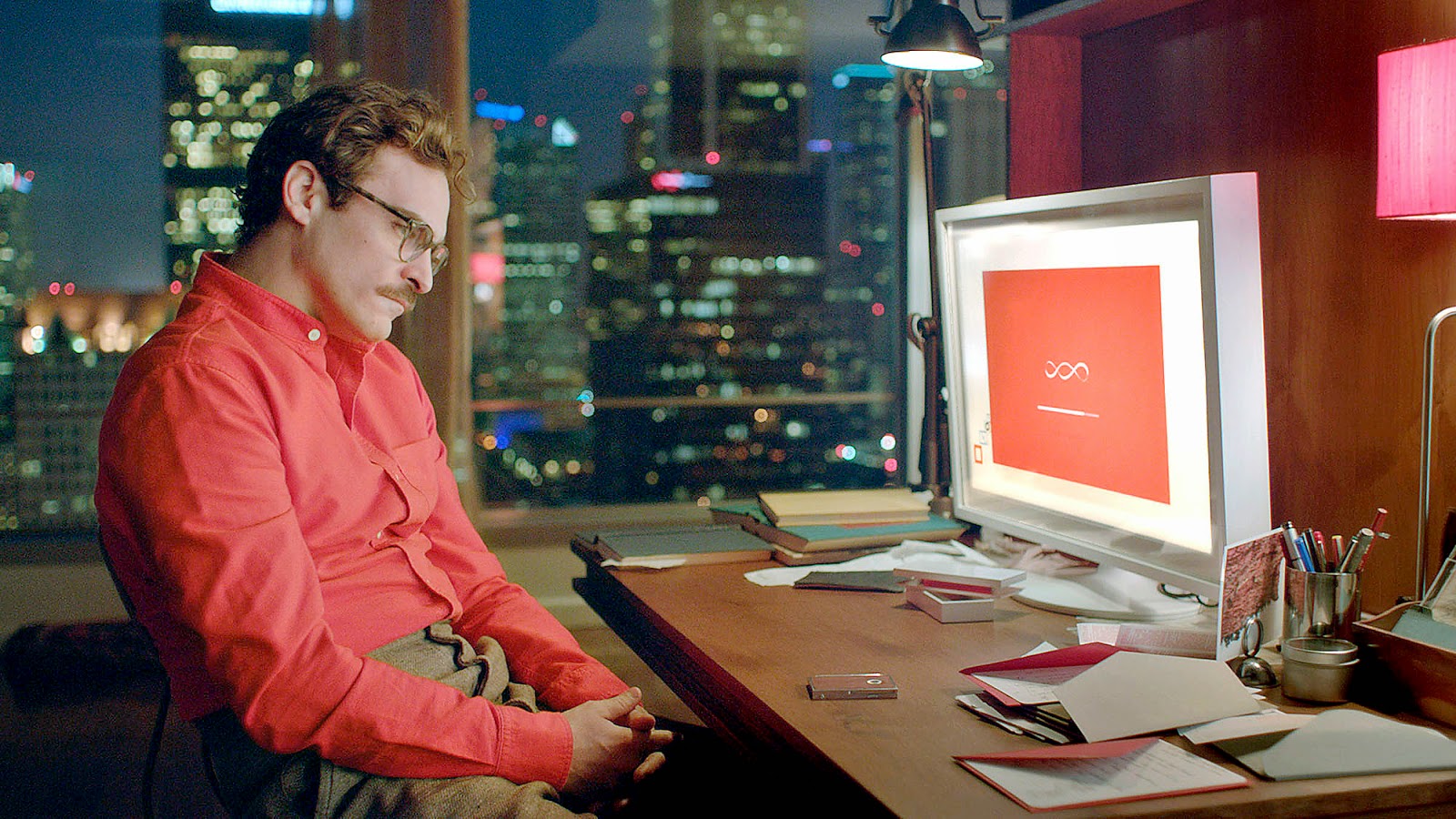
For those who may not already know, Spike Jonze's Her takes place in a near (and very plausible) future society where technology has become so advanced that it has drained much of the humanity out of humankind. It is a world both stunningly beautiful and eerily cold. Filmed in Shanghai, the architecture is amazing (and gorgeously rendered by the superb cinematography of Let the Right One In's Hoyt Van Hoytema) but it's sterile. There is no garbage, seemingly no crime, no hint of the messiness of our common everyday experience and, I must admit, having seen so many dystopian futures in movies, it's a refreshing change (visually the film resembles Andrew Niccol's GATTACA, but with a completely different ominous underbelly). Amongst these flawless towers of glass and concrete, a mass of human beings move in and out, completely isolated from one another. I noticed that in every crowd shot, although we have no sound, people's lips are constantly moving indicating that they are dictating something, talking to another person or, as we will later see, interacting with their operating systems. The story of Her could easily be told -- with very little alteration -- about any one of these people, but it chooses to focus on Theodore (no last name) played by a sweet but pathetic Joquain Phoenix. Theodore is a very sensitive yet socially awkward man who works for an organization that composes hand-written letters on behalf of other people (the term "hand-written" being a misnomer since they are printed on a computer and simply designed to look inscribed... which, of course, is consistent with one of the film's main themes about simulation replacing reality). Theodore's letters are among the company's most emotional and heartfelt, but his love life outside of work is a wreck as he is in the process of divorcing his wife of many years. Theodore purchases a newly invented operating system that is actually sentient (a "female" entity that dubs herself Samantha and who sounds a lot like Scarlett Johanssen) and soon forms an attachment to it/her. Interestingly, that attachment is returned by Samantha and soon love blossoms between them. However, as I learned myself from falling in love with a disembodied voice, difficulty soon follows as both members become dissatisfied with the nature of the relationship and want... more.

The conceit is a simple but brilliant one. Similar concepts have been explored before but in my experience not with quite the same brutal honesty and startling vulnerability that Her does. Some have likened it to Michel Gondry's Eternal Sunshine of the Spotless Mind (another melancholy sci-fi love story) and the comparison is apt, but I was actually reminded more of a different film, a strange but soulful little work called Lars and the Real Girl where Ryan Gosling plays another sensitive but awkward loner who forms a "relationship" with a blow-up doll and his whole community, out of sympathy for him, participates in the act. Both films focus on unusual romances between lonely men and the objects (and I emphasize the word objects) of their affection. Both premises seem like potential fodder for some pretty outrageous comedy but in fact neither film is especially funny... nor is trying to be. Although they certainly have their moments (one such sequence being Theodore's phone sex encounter with a bizarrely disturbed woman -- hilariously voiced by Kristen Wiig -- early in the film*), their general tone instead is one of sadness. They seem to be lamenting the absurd lengths to which human beings will go to simply form some kind of a "connection" that feels meaningful and they are posing the question of whether such connections are even possible the more reliant upon technology we become (i.e. as things move further away from the real and toward the virtual).

(*Note: The disastrous phone sex sequence is contrasted by a later scene where Theodore has sex with Samantha and it is a much sweeter, more intimate encounter. Jonze signals the difference by cutting to a black screen as we simply hear Theodore and Samantha "copulating." It both respects the characters (giving them their "privacy") and also equalizes them in that they both become mere voices in that moment.)

I should probably confess up front that outside of that amusing Siri commercial with Marty Scorsese ("Is that Rick.....? Where's Rick?" "*HERE'S RICK.*" "Nah, that's not Rick."), I know virtually nothing about anthropomorphized operating systems. That probably makes me the ideal audience for this film as I have friends in computer programming who have serious issues with it. In my mind the verisimilitude of the artificially intelligent OS is somewhat beside the point. The OS essentially serves as a metaphor, a placeholder for whatever entity we decide to invest ourselves in emotionally. It may require more imagination at certain times, but I was surprised at how much Her suggests the activity of loving someone/thing takes place in our own heads. While watching it I was reminded of the Scottish philosopher David Hume who held that we are unable to make direct contact with (and therefore have no actual knowledge of) reality but we can only make contact with our own ideas (which are derived from impressions formed by sense perception). I began to wonder the same thing about love. When we love someone, are we really loving them or are we just loving the idea of them that exists in our own mind? If the latter, then the degree to which my version of them corresponds to the actual them depends on how much I am willing to change myself to accommodate them. A film like Her manifests that question in an exaggerated but very provocative way.

Of course, none of these ambitions would mean anything if the film weren't splendidly produced. Spike Jonze's thoughtful writing and confident direction, the aforementioned visuals, the performances by the actors (both Phoenix and Johanssen do phenomenal work) and the bittersweet music score are all top shelf and make the movie's ideas all that more potent.

Although it took me well into the next year before I saw it, I am tempted to agree with those who call Her the best picture of 2013 (my previous pick being Rick Linklater's Before Midnight, another film about the various difficulties in long-term relationships). I was pleasantly surprised at how much it took the various positives and negatives associated with love (the joys, the miseries, the pettiness, the selfishness, the neuroses, the sacrifices, etc) and put them on the screen in an extremely powerful and evocative way. It made me uncomfortable at times. It was unsettling, but it was a very revealing look at human nature and, not least of all, it made me very grateful for the love I do have in my own life... at least, I think I love my wife. I don't think that I love only the "idea" of her that I've created in my own mind, an idea that first formed back when she was just an anonymous poster on IMDb and which got a bit more nuanced as she became a voice on the phone and eventually a flesh-and-blood person I could hang out with. Maybe I don't actually love Kristin. Maybe I am just, in a way, loving myself.

*thinks for a moment*

No, I think Hume was wrong. I don't love the idea of my wife. I love her... and I loved Her.

Tuesday, April 22, 2014

A Born Loser


The Coen brothers love losers.

I can't believe it took me this long to figure that out, but the Coens clearly have a soft spot in their hearts for individuals who try desperately to achieve success and yet fail. Barton Fink, Larry Gopnik, Ed Crane and even Sheriff Tommy Lee Jones... all characters who reached for something and yet fell short of their goal. Occasionally they make a movie about a "loser" who actually wins (Hudsucker Proxy, True Grit, O Brother Where Art Thou, etc) but those seem to be the exception rather than the rule and oftentimes their accomplishment comes more from luck than from their own ingenuity, skill or intelligence. In a cinematic landscape filled with protagonists who defy all odds to win the day, the Coens' focus on those who end up with the short end of the stick is rather refreshing.

 Llewyn Davis is the latest in a long line of Coen losers. He navigates New York's 1960's folk music scene trying to break through but never quite getting there. It's not because he's bad. Indeed he's quite good and we get many opportunities to see him play (the film could almost be considered a musical), but for whatever reason fame and recognition elude him. Is it cosmic justice for the numerous poor decisions he makes along the way (sleeping with his friend's wife, antagonizing his few friends, behaving selfishly and acting just generally self-destructive; in many ways he's his own worst enemy) or is it just bad luck? You don't get discovered but the guy who goes onstage after you becomes a huge sensation (just as some lost cats find their way home and others just wander the wilderness). The movie never tells us.

I love the Coen brothers and I loved Inside Llewyn Davis. It is, like all of their films, impeccably constructed with some great images (the look of the film has a subtle, melancholy beauty), colorful characters played perfectly by a fine cast, fantastic music (yet another soundtrack I'm going to gave to buy) and some truly hilarious moments. While not perhaps their best film (although lately I find ranking there movies a virtually impossible task), I'd dare say it's one of the best films of 2013.

 That's what I got.


Saturday, February 22, 2014

Robo-Robocop


One's ability to enjoy Jose Padhila's re-imagining of Robocop will probably be in direct proportion to how well one can forget the original. It is not a bad film by any means, and compared to the string of recent remakes, reboots and relaunches, it is probably near the top of the heap, but when put next to Verhoeven's sharp, satirical and eerily prophetic 1987 masterpiece, it is inferior in almost every way.

The plot, in broad terms, is essentially the same: in the near future, tough Detroit cop Alex Murphy is killed/critically injured, given a second chance at "life" as a cyborg police officer and eventually undergoes an existential identity crisis as he takes on the corrupt corporation that built him. It is in the particulars that the film establishes its differences: Murphy's wife and son play a much bigger role this time around, the suit's new design -- obviously influenced by the Iron Man franchise -- is sleeker and a somewhat dull all-black rather than the bulky shiny chrome of the original, the story still stops occasionally for media/exposition breaks (though rather than a news broadcast we are treated to amusing talk show clips with an alarmist Bill O'Reilly-like host) and while the first one dealt with issues relevant to the 80's (the rise of corporate America, the privatization of public institutions, the militarization of the police, the slow bleeding of our nation's economic resources, etc), this one, while still tackling some of the same issues, emphasizes more contemporary concerns (drone warfare, America's foreign policy, big brother-like surveillance, the increasingly blurred line between human beings and technology, etc). The whole thing is intelligently and competently done. All of the elements are in their proper place, but the whole enterprise feels... well, mechanical. While the first Robocop was infused with a thorough (and at times surprisingly moving) humanity, this Robocop so often feels like it is, much like the protagonist at various points in the story, on auto-pilot. It moves along at a relatively brisk pace but still seems to lack the energy or conviction of its predecessor. I found it holding my attention without really engaging me emotionally. The CGI, like all modern Hollywood movies, vacillates between very good and extremely cartoonish and the action is diverting without being especially thrilling (which is ironic given that this Robocop can both run and jump rather than just lumber along slowly like the original did).

What it's also missing, unfortunately, is the original's wicked sense of humor. Verhoeven's film was not only provocative in its socio-political observations and highly astute in its criticism of American culture, it was also REALLY damn funny. I kept waiting for a sequence with the biting hilarity of the original's Ed-209 eviscerating a hapless executive in a board meeting demonstration gone wrong. In fact, the film in general is pretty sanitized (one could even say "neutered"), drained not only of its namesake's extreme violence but also of its wild and unpredictable, but not incoherent, shifts in tone. This Robocop is very "safe" and "middle-of the-road" and it is reflected in its family--friendly PG-13 rating (whereas the original was forced to make cuts to receive an R instead of a dreaded X)

The cast is good: old Commissioner Gordon Gary Oldman and even older Batman Michael Keaton play the ying and yang of Omnicorp (the company that creates Robocop) and both are very effective. It's nice to see Keaton in a major movie again -- he reminds you of his ability to play a convincing, but not cliched "mustache-twirling" villain -- while Oldman brings nuance and complexity to his more sympathetic role of the Dr. Frankenstein to Robo's "monster." Jennifer Ehle, Jackie Earl Haley, Marianne Jean Baptiste and Samuel L. Jackson (a bit more restrained than I would like to have seen him) are also highlights. The weakest link, alas, is the actor playing Murphy/Robocop. When he's in the suit with the visor down, he works just fine, but since this version has him spending far more time with his face visible and his "humanity" present, it becomes painfully clear how welcome an actor with the charisma and eccentricity of Peter Weller would've been.

In the end, Robocop is a decent enough remake. I would buy it for a dollar, but I'd still buy the original at any price.

Friday, November 22, 2013

From the Archives: Faith & Suffering in Shadowlands


"Part of every misery is, so to speak, the misery's shadow or reflection: the fact that you don't merely suffer but have to keep on thinking about the fact that you suffer. I not only live each endless day in grief, but live each day thinking about living each day in grief."

Suffering is a part of life. At some point in our time spent on this Earth we are all confronted with this truth. Charles Grodin begins his autobiography It Would Be So Nice If You Weren't Here with the anecdote: "I remember crying once as a little boy (I forgot why) and thinking that if this was the best life had to offer, I wasn't so sure about going on." I mention this passage because it eerily reflects one of my own experiences. I also remember crying once when I was younger (like Chuck, I don't recall the reason or even the exact circumstances) and disliking it to the point that I wasn't so crazy about continuing on with this life if it was going to involve this. It's not that I was contemplating suicide or anything like that. I was just desperately searching for a way to "bargain" with life such that I wouldn't have to endure any more pain.

For some individuals this is where the dealing with the reality of pain begins and ends. My college professor once said that there are two kinds of people in this world: philosophers and drug addicts. The drug addict merely goes through life looking for the next distraction to keep himself occupied. The philosopher actually faces into the tough issues that life has to offer. He asks questions and seeks answers. Even as a youngster (though I was beginning to display "drug addict" tendencies in my desire to sidestep as much pain as possible) I was also already launching my tenure as a lifelong philosopher because in the midst of my tears I was asking a simple but vital question: "Why?"

"Why?" is a very important question. In fact, "Why?" may be the most important question a person can ever ask in his lifetime. The question of "Why?" particularly seems to surface in the face of extreme hardship. As the aforementioned college professor wrote once in a book: "Our questioning is not really from a desire to know the particular meaning of the particular event. More importantly, it is from a desire to be assured that it has any meaning at all." In other words, does my suffering serve some purpose? Is there meaning behind it? Or rather is it pointless and arbitrary? Is it simply another random occurrence in a cold, unfeeling and ultimately absurd universe? Well, as a Christian, quite obviously I believe that there is meaning to suffering (and consequently to life) and some of my favorite stories deal with this very theme. That's why, when I heard a while back about RC's "Film + Faith Blog-a-thon" over at Strange Culture, I knew exactly which film I was going to write about... well, it was this one or The Mission.

Some of my real-life heroes have been extraordinary individuals who stood up against incredible odds to fight for some form of liberty for themselves and their fellow man (Martin Luther, Abraham Lincoln, Mahatma Gandhi, Oskar Schindler, etc), but some of my other heroes happen to be a more mundane, less "romantic" historical figures. One in particular holds a special place in my heart. This fellow didn't start any great revolutions. He didn't free or save millions of people. He was just an ordinary guy who dealt with what life threw at him in a very real and very forthright way. It is precisely the "ordinary-ness" of author C.S. Lewis that makes him, in my mind, heroic and noble. Ironically, when it comes to Lewis' writing, I am not necessarily his biggest fan. His fiction (primarily the Chronicles of Narnia series) is pleasant enough but a little too allegorical for my taste (I actually prefer the books of his friend and fellow "Inkling" J.R.R. Tolkien), but I love his more "philosophical" efforts (such as Mere Christianity, The Screwtape Letters, The Great Divorce, etc). Although I admit I haven't read as much of his work as I would like to, the reason I respect and admire Lewis has less to do with his achievements as a writer and more to do with his experiences as a human being.

Though raised in a religious family, Lewis became an atheist in his teen years. It was actually Tolkien who helped convert him back to theism and Lewis ended up becoming one of the great Christian apologists. Certainly no stranger to suffering (having fought in the trenches of WWI), Lewis wrote some thought-provoking meditations on reconciling the existence of evil and the reality of human suffering with the concept of a righteous, loving and omnipotent God in such works as The Problem of Pain. Lewis' theodicy was well-developed, intelligent and rational.

"God whispers to us in our pleasures, speaks to us in our conscience, but shouts in our pains: It is His megaphone to rouse a deaf world."

Then something significant happened. Lewis met and fell in love with an American woman named Joy Gresham. Joy moved to England with her two sons (David and Douglas) and she and Lewis were married in 1956 and lived relatively happily together for four years. In 1960, Joy died of Bone cancer and a short time later, in 1963, Lewis himself followed. During the intervening three years, Lewis struggled quite a bit with the loss of Joy. Though it was not Lewis' first occasion doing so (his mother also died of a cancer when Lewis was very young), for some reason Joy's death seems to have affected him deeper than anythings else he had ever endured up to that point. This challenged Lewis' faith to an incredible extent and in his book A Grief Observed, Lewis lays out very honestly and openly not only the bereavement felt over the death of his beloved wife but the anger, the fear and the general questioning felt in the face of a possibility that God is not real or, perhaps worse, that He is not good. The text is such an outpouring of a person's emotions, doubts and vulnerabilities. To read A Grief Observed is to see a man lay his innermost being completely bare, to gain insight into a soul in turmoil.

"No one ever told me grief felt so much like fear."

Interestingly, A Grief Observed was initially published under a pseudonym and never mentioned his wife by name. Thus, a number of Lewis' friends recommended the book to him thinking it might be of some help to him. I find this scenario not only ironic but also extremely revealing because it suggests that Lewis' own friends didn't recognize him in his writing. This indicates to me that his musings in A Grief Observed were unlike any writing he had ever done before. Indeed, I first read it during somewhat of a dark period in my own life and found that it "felt" completely different from, say, Mere Christianity (which I had also recently read at the time). The Lewis who wrote before Joy's death and the Lewis who wrote after it seemed to me like two completely different men. It's as if the first Lewis had it all figured out and the second Lewis wasn't quite so sure anymore. The Lewis who wrote A Grief Observed is the Lewis whose perspective on pain was really put to the test, who was given more of an intense taste of the kind of acute, almost crippling, anguish and heartache that life has offer. Thus, he gained a deeper understanding and more profound appreciation of what pain truly is, what it does to us and, of course, whether or not it has purpose.

"Experience: that most brutal of teachers. But you learn, my God do you learn."


Being that C.S. Lewis is one of my heroes and his story is an extremely moving one to me, it should come as no shock to people that one of my favorite films is Richard Attenborough's Shadowlands as it dramatizes the period in Lewis' life I have described above. Shadowlands actually began as a 1985 BBC-TV movie written by William Nicholson starring Joss Ackland and Claire Bloom (of which I've only seen bits and pieces a long time ago) and was then adapted by Nicholson into a stageplay. It was this stageplay that served as the basis for the 1993 film which features the great Anthony Hopkins as Lewis and the effervescent Debra Winger as Joy. While I've been told that the earlier version is far more subtle, less "Hollywood" in its style and sensibilities and contains fewer liberties taken with Lewis' story (the two Gresham sons, for example, are combined into one child for the '93 version) it would be a mistake, I think, to dismiss the later version's "gloss" for lack of substance. Certainly the film is handsomely shot and exceptionally well acted but, in fact, there is quite a bit about it that is very "un-Hollywood." First off, while some might find it emotionally manipulative I find it to be very restrained and low-key. Also, while many films are content to simply use tragedy as a means for injecting "drama" into a love story (cancer almost always serves quite effectively in that capacity) without unpacking its deep and lasting effects on real flesh-and-blood human beings, Shadowlands faces directly into the provocative complexities of dealing with suffering and death... especially in the context of spiritual faith.

Sometimes it seems to me that faith is perceived nowadays as a kind of unflinching optimism; a delusional reassurance in spite of all the evidence to the contrary, that "all will be well;" it amounts to little more than closing one's ears, covering one's eyes and singing "LA! LA! LA!" in the face of any and all adversity. In this sense, the idea of faith is almost always associated with blindness or ignorance, a phenomenon with which I must admit I don't necessarily see a lot of virtue. In essence, that kind of faith is really just another way of distracting one's self, another drug for the addict to take to deaden the pain rather than actually deal with it. I'm not so sure that God wants us to be a bunch of "Pollyannas," only seeing good everywhere and not admitting that oftentimes things just plain suck, taking pleasure in our pain as if we were masochists. I think He wants us to look squarely into the darkness that exists and acknowledge it for what it is (this includes seeing the darkness in ourselves as well). A lot of the time this involves anger, sadness and a whole other range of sensations that really don't feel very good. If one can emerge from the other end of this tunnel of misery and still have hope, then I think one can be more assured of his faith.

This is where pain and suffering can serve a purpose. A faith that has actually learned to confront the harsh reality of pain seems to me to be a deeper and stronger faith. It's a faith that, as the book of James says, is "tested by fire." Naturally that doesn't make the testing process itself any easier. Lewis understood that but he didn't really come to grips with it until Joy was taken from him. He did not abandon his faith before his passing, but he did have great difficulty holding onto it. In the end, Lewis' faith was a well-earned one. He held his beliefs not because he simply refused to confront reality, but rather because he confronted reality. He did not have blind faith. On the contrary, he had eyes to see.

Just as I would recommend Lewis' book A Grief Observed to anyone going through a rough period in their life, I feel I can recommend Shadowlands to anyone who has ever asked "Why?" in the midst of a tough time. It may not make anybody's list of great films (although it did make the "100 Most Spiritually Significant Films" over at Arts & Faith) but on the subject of faith, I happen to think it is one of the greatest out there. It doesn't provide any huge, enlightening answers, but it does ask some hard questions and poses some thought-provoking ideas. Like C.S. Lewis himself, the film is humble but passionate, warm but melancholy, terribly sad and yet simultaneously full of immense joy. As Jack (Lewis' nickname) and his wife discuss in a scene set in the beauty of a picturesque countryside (but with rain serving as an almost symbolic counterpoint):

JOY: It’s not going to last.
JACK: We don’t need to think of that now. Let’s not spoil the time we have together.
JOY: It doesn’t spoil it. It makes it real.... What I’m trying to say is that the pain then is part of the happiness now.


In closing, I want to briefly mention something that I think is interesting. As it does to all men, death finally came C.S. Lewis on November 22, 1963. If that date looks at all familiar to you it's because it was the same day that JFK was assassinated and from a global socio-political perspective that was naturally the more significant event. Thus, every newspaper the world over splashed across their front pages headlines of Kennedy's untimely demise. So, while everyone was in shock and mourning the passing of one of America's most handsome, most charming, most charismatic and, consequently, most popular presidents ever, an old, but great, man was quietly leaving this planet in a manner very befitting the time that he spent on it.

"You play the hand you're dealt. I think the game's worthwhile.”

Tuesday, August 27, 2013

Not Quite Dredd-ful


Maybe I'm a little late to the party on this one but it really is becoming more and more apparent to me what an enormous influence Chris Nolan's "Dark Knight" trilogy is having on current comic book adaptations.

Like its 1995 counterpart starring Sylvester Stallone, last year's Dredd is based on a 1970's British comic book series (unread by me) about a dystopian future society where the "cops" are in fact judges with the power to try, convict and execute criminals on the spot (this sounds like a premise with potential but unfortunately neither film really does much with it). From a technical perspective, there is little to complain about in Dredd. The film has a gritty, grainy look that makes its sprawling polluted metropolis seem like an actual place. The majority of it takes place in a massive residence building which gives the film a suspenseful, claustrophobic atmosphere (sort of like a futuristic Die Hard) and the digital effects are most convincing when used to make the oppressive environment more believable. They are somewhat less convincing when trying to make gun shot wounds seem real. The film also has a number of gorgeously stylized sequences that are almost hypnotic in their visual beauty (the plot centers around a drug called "slow-mo" that makes everything seem slowed down; imagine the cinematic possibilities). Karl Urban, despite having half of his face hidden through the entire film, provides menace and charisma (and can grimace just as good as Stallone can) to a character with very little personality and Lena Headly gives a fantastic, eccentric performance as a truly terrifying and evil villain named Ma-Ma.

What's missing from the whole enterprise, frankly, is just good old-fashioned fun. When compared with the cheesy, colorful big screen comic incarnations of the late 80's-90's (Batman, The Shadow, The Phantom, Darkman, etc), I am starting to be of the opinion that contemporary comic book movies just take themselves way too damn seriously. At a certain point in the story I found myself thinking, "This movie is holding my attention, but I am not really enjoying it." For all of its misfires, the '95 film at least realized the absurdities of its central conceit and made no bones about it. I saw the original in the theater with my father and a mutual friend and while none of us would have praised Judge Dredd as being a fine film by any means, we all enjoyed it and laughed heartily as we talked about it afterward. Dredd is so dark, so grim and so humorless that there is virtually nothing in it to laugh at or even really smile about. I think I watched the entire film with a "Dredd-like" unamused expression on my face. Furthermore, its stone-cold soberness throws the sillier aspects into even sharper contrast. In that regard Stallone's rendition might have the upper hand. It was incoherent but it was not inconsistent. This Dredd is both.

Also, the film is EXTREMELY violent, with a body count that must number in the hundreds (most of them innocent civilians). I am not at all squeamish when it comes to onscreen violence, but it is so relentless and unflinching here that it becomes sort of numbing after a while. A couple times I was reminded of Paul Verhoeven's Robocop, a comic book movie (though it has no "direct" inspiration) that also had shocking violence but delivered it with such panache that it still managed to be an enjoyable experience. Robocop was both serious and fun, gory but also witty and satirical, cynical but not nihilistic. It demonstrates that it is possible to make a dark, stylish and grown-up "superhero" movie that doesn't collapse under the weight of its own solemnity. I have little hope that its upcoming remake will strike the same delicate balance and will instead probably err more on the side of the bleak ugliness that Dredd wallows in.

Unlike its predecessor, which did not charm the critics, Dredd received generally positive reviews. This did not, however, prevent it from following in the footsteps of its predecessor financially as it flopped at the box office. This is probably unfair since it is not really a bad movie. In many ways it is superior to the '95 version. It's just so joyless, so ugly, so utterly devoid of any modicum of self-awareness that if, for some inconceivable reason, I were to suddenly feel the urge to watch a "Judge Dredd" movie, Stallone's is probably the one I'd reach for.

Tuesday, June 11, 2013

From the Archives: They Don't Make Superheroes Like They Used To

Note: This Friday Man of Steel, the Chris Nolan-produced/Zack Snyder-directed reboot of the Superman franchise, opens in theaters and in tribute, I have dug up a piece I wrote on my old blog shortly before the release of the previous failed attempt at a reboot: Bryan Singer's flawed but somewhat underrated Superman Returns. I'd like to believe my writing has vastly improved since then, but while I may have slightly changed my thinking on one or two points, I still agree wholeheartedly with the essential core of my thesis. Thus, I reprint it here with no changes whatsoever.


In a few weeks Bryan Singer's Superman Returns opens worldwide and it is a movie that has been a long time in coming (at one point the film was to be directed by Tim Burton, written by Kevin Smith and starring Nicolas Cage; I think I can safely speak for everyone when I say: "Thank God that didn't happen!"). Needless to say, I'm very excited about this event. I realize I'm advertising my hopeless "geekiness" with this blog, but I've long been a "Superfan." He's always been among my top three favorite comic book heroes (the other two being Batman and Spider-man; whoever occupied the number "1" spot depended on what phase of my life I was going through at the time).

In response to the upcoming release, the IMDB used its "daily poll" feature to ask its members to vote on which superhero was better: Superman or Batman. The results were interesting if, admittedly, not that surprising. Batman got a whopping 67% while Superman only got 15%. 10% said, "I like both equally" and 8% said," I don't like either." I have actually observed, in recent years, that Superman's "approval ratings" have dropped significantly and I couldn't help but wonder why that is. Superman used to be considered the greatest of the superheroes. In fact, Superman was essentially the first superhero, the "Adam" if you will. Without Superman there would be no Batman, Spider-man or anyone else. Superman used to be looked upon with awe. He was admired. He was a symbol for "truth" and "justice" and all that stuff! Why has the Man of Steele fallen into such disfavor in recent years? Why has his popularity waned so drastically and his cultural status declined so monumentally?

Is it the suit? Are the bright blue tights with the red cape, boots and the large red-and-gold "S" not only unimpressive anymore but downright corny? Perhaps its the sheer implausibility of his disguise. While Peter Parker and Bruce Wayne protect their secret identities by wearing masks that cover at least half their faces, all Superman does to become Clark Kent is put on a pair of glasses. Is it just too much anymore to accept that sharp-eyed journalist Lois Lane can't tell the difference between the guy she loves and the guy she works with? Is it the pantheon of powers that Superman possesses? Super-speed, super-strength, x-ray vision, heat vision, flight, super-breath... Do people just think it's too much? Maybe it's the invulnerability in particular. Maybe folks are just tired of Superman not being affected by anything (besides kryptonite of course). Maybe they expect that their heroes be subject to some harm or else there's no suspense. Then again, it might be the villains. Perhaps people prefer a whole rogues gallery of baddies for a hero to combat. I mean, Batman has a colorful array of nasty characters hes constantly fighting (Joker, Penguin, Catwoman, Riddler, Scarecrow, etc), as does Spider-man (Green Goblin, Dr. Octopus, Venom, Sandman, Vulture, etc), while all Superman really has is Lex Luthor (and to a lesser extent Brainiac).

Any one these things could have contributed to Superman's fall from grace, but I think it's something else that has caused him to lose his appeal, something that makes him, in the eyes of today's youth, not quite as "cool" as Batman, Spider-man or Wolverine, something that has actually caused my own personal respect for the character to increase: namely, his righteousness. This is a theory I've been formulating for a while now and I'd like to lay it out now.

Of all the comic book heroes out there, Superman is the only who is naturally good. He has no ulterior motives for fighting crime. Batman's is revenge (he saw his parents murdered when he was a child) and Spider-man's is guilt (he feels responsible for the death of his uncle), but Superman does good for its own sake. He is a truly virtuous, god-like individual, his physical and moral perfection, his extreme strength and incorruptible nature, used to be the very characteristics that made him worthy of respect and emulation. However, the fact that Superman is now referred to as an overgrown "boy scout" (both in and out of the comics) demonstrates that these characteristics have lost their luster. Superman is now considered "dull" or "two-dimensional." Heroes who are darker and more angst-ridden are called "cool" or "a badass." At the very least, they are more complex and therefore more "believable," i.e. there's a greater chance that these characters could actually exist in our own reality.

Understand that I'm not saying that there is anything wrong with these other heroes. On the contrary, I am just as much a product of my culture as anybody else. I love these other heroes. I am very drawn to the inherent drama of the ongoing struggle that Bruce Wayne he has with his own dark self. I also love the realistic, and oftentimes humiliating, problems that Peter Parker has to contend with. I find these multi-layered universes are, in fact, sometimes more interesting than the fantasy world of Superman, but what saddens me is that these worlds and their heroes are now being embraced to the exclusion of Superman. It is understandable that we want our heroes to be more like us (fallible, prone to temptation, at times selfish and weak, etc) but what we are losing in the process is an ideal and that is exactly what Superman is: an ideal. He represents not who we are, and not even who we could be, but who we should be. Superman personifies the type of end goal we ought to strive for, even if we never actually get there.

When Superman does indeed return to the big screen later this month, how the film is received should be an indicator of what we as a culture think of him. Does society still care about exploits of a person who acts completely selflessly, who helps weaker individuals without any sort of desire for personal gain? Is such a superhero still worth our time? Well, here's hoping.

Monday, August 20, 2012

If I Had a Sight & Sound Film Ballot: Damian Arlyn's Top 10 Films of All Time


Before proceeding with this post, a quick mea culpa is in order. In spite of declaring my desire to write more for this blog, it has been almost half a year since I last posted anything and I can offer no excuse other than to admit that I've had difficulty finding the motivation. When I was contributing pieces to the blog of my friend Ed Copeland (who, for health reasons, recently decided to take a more solely hands-on approach to managing his site), I had deadlines to help compel me to write something. Anything. When that went away, much of the drive to write went with it. At any rate, for those few individuals who may follow this blog, I apologize. Fortunately, a recent event has incited my passion and enthusiasm for discussing film once more and has provoked me to compose the following piece. Hopefully I can be disciplined enough to maintain a real presence online once again.

Now, to the task at hand. Although there are innumerable top 10 lists out there, any real film-lover knows that the one published every ten years by the British Film Institute's Sight & Sound magazine is considered THE top 10 list. Over a thousand prominent critics and filmmakers are asked to submit their picks for the "greatest films ever made" and the results are always interesting. The most recent list, however, incited some debate and has even sparked a series of articles at The House Next Door wherein writers who did not participate in the official poll have submitted their own personal top 10 lists. Several of my film-blogging friends have contributed and I have enjoyed their lists immensely, although I have also been somewhat envious because, to put it in childish terms, I wanted to "play" too. Then I remembered that I had a blog. So, I have decided to publish my own list here at CINEMEMORIES.

The following titles are arranged chronologically and they come, of course, with the usual disclaimers: it is not necessarily a list of "favorites" (as there are many films I truly love but did not include) nor even a definitive "best" list (as there are some films that I would consider in many senses superior to a few of these, yet I chose not to include those either) and it could change tomorrow blah blah blah. What I can say unashamedly is that each of these films is not only of great significance to me personally, but is also worthwhile for anyone to see... for each title deserves, if nothing else, to at least be part of the dialogue as to what the "greatest films of all time" are.


City Lights (Charles Chaplin, 1931). There's a scene in Richard Attenborough's serviceable 1992 biopic Chaplin where a frustrated Charlie (flawlessly played by Robert Downey, Jr.) is agonizing over how to communicate visually to an audience that a blind flower girl has mistaken his kindly Tramp character for a wealthy man. Charlie's brother pleads with him to make the film a talkie and have the Tramp simply TELL her that he's rich, but Charlie adamantly refuses knowing that it would "ruin the magic." The solution, arrived at by Charlie as he watches someone get into a vehicle to drive away, is to have the girl hear a car door slam and assume that is the Tramp's automobile thus allowing him to quietly sneak away without her ever knowing the truth. Though the exchange in Attenborough's film was most likely imagined, the filmmaking obstacle it dramatized, as well as Charlie's brilliantly graceful solution, illustrates why Chaplin was such a genius and why City Lights is considered his masterpiece. Chaplin did indeed resist the transition to sound for over a decade (City Lights would be one of his last "silent" pictures) although it meant that he had to work even harder than his colleagues to make audiences laugh and/or cry... and does he ever do both here. Not only is the film delightfully funny but the final scene is one of the most touching ever committed to celluloid, with or without talking.


Citizen Kane (Orson Welles, 1941). "The remarkable thing about Shakespeare," English poet Robert Graves once wrote about the man considered to be the greatest writer in the English language, "is that he is really very good - in spite of all the people who say he is very good." There is no quote I think that better articulates the phenomenon of Citizen Kane. Since 1962 Orson Welles' magnum opus occupied the #1 spot on Sight & Sound's list (until it was controversially replaced by Hitchcock's Vertigo this year, but more on that later) and was blessed/cursed with the moniker of "greatest film ever made." This characterization kept the film simultaneously revered and reviled for over 50 years, but whether or not it truly deserves its alleged place in film history -- whether it truly is the greatest film ever made, one of the greatest or merely the product of a half a century of propaganda-- is ultimately irrelevant. Citizen Kane is a great film and as long as the conversation about the artistic merits of cinema continues, Kane will always have its place.


La Strada (Federico Fellini, 1954). Man, did Giuiletta Marsina have quite a face. So expressive. So beautiful. Her sweet and innocent, though at times sad and lonely, waif of a character is the heart of La Strada (which translates "The Road"), the fourth film made by her husband Federico Fellini. La Strada won the Oscar for Best Foreign Language Film in 1954 and made Fellini an internationally acclaimed filmmaker. Though it built upon the foundation laid by the Italian neo-realists (of which Fellini was a part) it was also, conversely, a reaction against it. La Strada is essentially a "realistic fable" that relates the melancholy but whimsical tale of a quirky young woman named Gelsomina who is bought by a strong man named Zampano (Anthony Quinn) to assist in his traveling act. Along the way they encounter another circus entertainer (known simply as the "fool") who imparts words of wisdom to Gelsomina but who antagonizes Zampano. This triangle results in a series of tragic events which culminate in one of the most powerful and heartbreaking final scenes in any movie. As the obnoxious guy from Annie Hall, who complains about how indulgent a filmmaker Fellini could be, is forced to admit: "Granted, La Strada is a great film." Indeed it is, sir. You may have been wrong about Marshall McLuhan but you were right about that.


Psycho (Alfred Hitchcock, 1960). A friend asked me what I thought of Vertigo taking the top spot in the latest Sight & Sound poll. Honestly, I have no problem with it. Just because I didn't place Vertigo in my own personal top 10, does not mean I take issue with its being considered "the greatest film ever made" (at least no more than I do with any other film being called such... well, except perhaps The Waterboy). Vertigo is a masterpiece and I do love it. Nevertheless, I always have been and probably always will be a Psycho guy. From a technical standpoint, Psycho is just as clever, manipulative and cinematic as Vertigo. From a storytelling standpoint, it's just as dark, provocative and emotional as Vertigo and from a thematic standpoint, it's just as deep, rich and tragic as Vertigo. What probably makes the latter seem more sophisticated than the former (and what causes many to select it over Psycho) is pedigree. Being a horror film, Psycho's subject matter is far more lurid, seedy and vulgar than Vertigo. There are no elegant blonde beauties waltzing around in stylishly colorful outfits to the gorgeously delicate strains of Bernard Hermann's bittersweet love theme. What we get instead is a slutty blond girl who steals thousands of dollars and then gets brutally stabbed to death in black-and-white while Hermann's violins shriek at us crudely. Vertigo, like its protagonist Scottie Ferguson, may be disturbed, but there's no denying that Psycho, also like its main character Norman Bates, is sick. That sickness doesn't mean it can't also be high art, but its perversity spawned a whole host of trashy imitators who, quite frankly, aren't even worthy to clean Psycho's shower. Maybe it will always be somewhat devalued by its association with a fairly ignoble genre, but even if we punish the film for the company it keeps forever, Mother still gets the last laugh.


The Wild Child (François Truffaut, 1970). While many cinephiles would probably choose 400 Blows (a film I love by the way) as Truffaut's greatest work, I happen to be irresistibly drawn to The Wild Child. Based on the true account of Victor of Aveyron, a feral boy who was captured and then re-introduced to 17th century French society, Wild Child benefits greatly from the onscreen presence of Truffaut himself. Playing Dr. Itard, the teacher who patiently educates, socializes and ultimately civilizes young Victor, Truffaut's natural warmth and compassion comes through as clearly on camera as it does from behind it. It also presents some of the most powerful and hopeful scenes of a person rediscovering their innate dignity and humanity I've ever seen. There's an incredibly moving sequence where Itard, concerned that he has simply trained a pet rather than awoken the boy's inner sense of morality, makes the difficult decision to punish Victor for actually obeying him and Victor briefly rebels (biting Itard's arm in the process) which the doctor considers a great success. Jean-Pierre Cargol, the young actor who plays the titular child, does a phenomenal job of seeming genuinely savage and animal-like. Similar to Patty Duke in The Miracle Worker (a story Truffaut wanted to adapt before learning Arthur Penn was already doing so), his gradual overcoming of his natural "handicaps" seems authentic. It's a superb performance, one of the best ever given by a child actor, and it is no surprise given that he was directed by one of the greatest child directors ever. In many ways, Wild Child is just as personal and autobiographical a story for Truffaut as 400 Blows is. Whereas the latter is about Truffaut's youth and falling in love with film, the former is about his adulthood as a filmmaker and the "coaching" he ends up doing of so many little children as a result. It's no coincidence that the film was dedicated to Jean-Pierre Léaud, the boy who worked with Truffaut on 400 Blows and four other films over a period of 20 years.


Apocalypse Now (Francis Ford Coppola, 1979). I find that great art often transcends its subject matter and in the case of great films, that includes its genre. Apocalypse Now (Francis Ford Coppola's Vietnam epic based on Joseph Conrad's Heart of Darkness) is ostensibly a war movie but in the hands of director Coppola, cinematographer Vittorio Storaro and editor Walter Murch, it becomes much more. The story begins relatively straightforwardly (Martin Sheen's special ops captain Ben Willard is ordered to proceed downriver and assassinate Marlon Brando's Col. Kurtz who has apparently lost his mind and is running his own rogue military command, composed primarily of natives, in the heart of Cambodia) but as the film goes on and Sheen gets deeper and deeper into the heart of the jungle, it becomes more of an abstract experience: imagery becomes symbolic, colors become impressionistic and dialogue becomes philosophical. The finale is a like a hallucinogenic nightmare from which Willard, though he completes his assignment, can never wake up. The mission is essentially a journey into the darker recesses of his own soul and what he finds shocks and horrifies him. Many consider Apocalypse Now pretentious and indulgent but most films that plumb the depths of human nature tend to be. It is also criticized for having very little connection to historical reality, but again I think this misses the point (the film is basically an allegory). For me, it is a quintessential example of what I call "meditative" cinema and it is, quite honestly, astonishing it turned out as well as it did given the immense obstacles Coppola was forced to overcome to create it (and which were chronicled in the documentary Hearts of Darkness: a Filmmaker's Apocalypse). Years later, Coppola revisited his film with the extended Apocalypse Now Redux and although it does have one or two interesting additional sequences, I prefer the original. You can have too much of a good thing.


Crimes and Misdemeanors (Woody Allen, 1989). In his novel The Brothers Karamazov, Dostoyevsky wrote that if God doesn't exist, "everything is permissable." Woody Allen's Crimes and Misdemeanors (an obvious variation on the title of another Dostoyevsky tome Crime and Punishment, only notice that Allen does away with the "punishment") is an exploration of that very idea. It tells two parallel stories (one of a man, played by Martin Landau, who has his former mistress murdered and the other of an unlucky filmmaker, Allen himself, whose marriage is falling apart and who is becoming attracted to another woman). In the film's final scene, the two stories converge in a conversation where the difference between fantasy (as it's usually depicted in movies) and reality (as Allen perceives it) is articulated. In the vein of Allen's idol Ingmar Bergman, Crimes and Misdemeanors is about the absurdity of guilt, the indifference of the cold and unfeeling universe and the ways in which we human beings cope in the face of such hard, bleak concepts (Allen would later revisit some of these themes in Matchpoint). Much of the imagery throughout powerfully illustrates this (Landau's character is an opthamologist and his rabbi friend Sam Waterston is going blind, which indicating he doesn't "see" the truth about God's non-existence). Woody Allen, a known atheist and pessimist, is one of my favorite filmmakers (my most beloved of his films being Manhattan and Purple Rose of Cairo, both of which it was very hard to exclude from this list) and it seems strange to me sometimes that his work should resonate so much with me given that I am neither an atheist nor a pessimist. Nonetheless, there is a lot of insight in his work (Allen is particularly good, for example, at dramatizing the sentiments of the biblical book of Ecclesiastes: "Vanity, vanity, all is vanity") and it keeps me coming back to them. In many ways he has, if you'll pardon the expression, "eyes to see."


Schindler's List (Steven Spielberg, 1993). Whenever someone decides to make a "top 10," "top 20," "top 50" or "top 100 greatest films ever" list, my first tendency is to scan the entire thing looking for this title. If I don't find it, my respect for the list immediately drops a point (Note: I actually had just such an experience recently when I discovered that not a single person voted for Schindler's List in the most recent Sight & Sound poll). Acclaimed and criticized in its initial release, Steven Spielberg's three hour-plus docudrama is a landmark film in the history of cinema as well as a major turning point in the career of its director. A filmmaker known primarily for technically flawless and unapologetically juvenile escapist fare, Spielberg's restrained, dignified and honest treatment of the true story of a German industrialist who risked his reputation, fortune and life to save 1,100 Jews from extermination during WWII was as surprising as it was inspiring. It is also, if I can get a bit more personal for a moment, a seminal film in my own development (both as a cinephile and as a human being). It may not be the greatest "Holocaust film" ever made -- many seem to prefer Alan Resnais' harrowing 1955 documentary Night and Fog -- but I would argue that, due its immense recognition and the way it brought the topic into the mainstream cultural dialogue more than any other film had before or since, it is the most important. Furthermore, like Apocalypse Now, Schindler's List transcends its subject. It becomes a rumination on pure ideals: good, evil, courage, fear, love, hate, etc. Very few films reach as high and dig as deep. Very few films juxtapose humanity's frightening capacity for sheer wickedness with its incredible potential for goodness more clearly or more gracefully. It may very well be, as I have not infrequently called it, the best film I've ever seen or will see (although the final film on this list comes close) and should it ever occupy the #1 spot in Sight & Sound's poll, you will not hear me complaining.


The Red Violin (François Girard, 1998). In Jr. High I remember reading a short story about a coin which traveled all over the world, was owned by many different people, was used for both good and evil purposes and which "lived" far longer than any of individuals who possessed it. I remember being fascinated by that idea and the prospect of asking any object (assuming it could magically speak) about its adventures. What sort of stories would it tell? Well, The Red Violin dramatizes that very scenario. The object in question is a violin known for the eminence of its creator as well as for its distinctive red-colored varnish and the film chronicles, in five different stories which span four centuries and several continents, a remarkable journey from its origin in 17th century Italy to the hands of an appraiser (played by Samuel L. Jackson) in modern-day Montreal. The Red Violin is legendary because it is no ordinary instrument and the film The Red Violin is brilliant because it is no ordinary film. It is dark, mysterious, hypnotic, unsettling, lush, romantic, ambitious, soulful... it is everything that a movie can and should be. It also has, thanks to composer John Corigliano, one of the most hauntingly beautiful scores ever written for a motion picture.


The Tree of Life (Terence Malick, 2011). Once in a blue moon, we see a movie that reminds us of why we watch movies in the first place, what we are seeking when we venture into that dark room to gaze at light flickering on a screen. We see a film that produces the kind of effect in us (an intense emotional, spiritual, intellectual and existential experience) that only films can stimulate. It is awe-inspiring and ambitious while simultaneously personal and intimate. The Tree of Life was that movie for me. Though it may seem strange to include a film that was released just last year in a list of the ten greatest films ever made, I believe that Tree of Life deserves it. Praised and condemned in equal measure since its 2011 Cannes premiere, Terence Malick's glorious two-and-a-half-hour tone poem takes its audience on a grand odyssey from the beginning of the universe to the troubles of an ordinary family in 1950's Texas to the end of all creation and finally to an enigmatic "no man's land" where time, space and identity seem to merge into one. In terms of style, scope and themes, it has been aptly compared to Kubrick's 2001, but (and I realize this is probably cinematic heresy), I think Tree of Life is better. When I first saw it in the theater, I was dumbstruck. I wasn't exactly sure what I had seen, but I knew I had just seen something extraordinary. It took several more viewings, not to mention reading a whole host of pieces on it (both positive and negative), for me to clarify my thinking and form a precise opinion on the film... and it is this: though it may sound hyperbolic, Tree of Life is not only a pure manifestation of the power and potential of cinema, it is the universal human journey expressed beautifully in a stunning marriage of words, images and music. It is sublime. It is magnificent. It is virtually a religious experience and it is, quite simply, one of the best films I've ever been seen. If movies can do that, they can do anything.


Runners-Up: Singin' in the Rain, The Seventh Seal, Unforgiven, The Grapes of Wrath, E.T., The Exorcist, Taxi Driver, The Shawshank Redemption, Blade Runner, The Mission, The Bicycle Thief, Lawrence of Arabia, Double Indemnity, The Godfather, Amadeus, Die Hard, Mr. Smith Goes to Washington, Dr. Strangelove, JFK, Aguirre: the Wrath of God